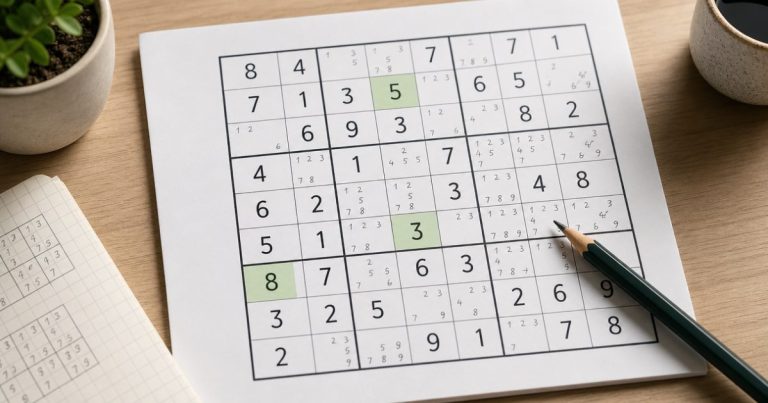
An almost empty Sudoku grid can seem to offer nowhere to begin. Usually, you don’t need to spot a number instantly. You make the first move by narrowing the possibilities until one placement is forced.
Start with the rows, columns, and 3×3 boxes that contain the most given numbers. For each promising empty cell, eliminate the numbers already used in its row, column, and box. Place a number only when the evidence makes it certain. If no cell is solved immediately, use notes and scan the puzzle systematically instead of guessing.
Remember the three rules that control every move
A Classic Sudoku puzzle uses a 9×9 grid divided into nine 3×3 boxes. Every number from 1 to 9 must appear exactly once in each:
- row
- column
- 3×3 box
These rules work together. A number missing from a row is not automatically allowed in every empty cell in that row. The cell’s column and box may rule out most of those positions.
Choose the most constrained area first
Look for rows, columns, or boxes that already contain several given numbers. They have fewer empty spaces, so their missing digits are easier to identify. A nearly complete box is often a useful starting point, but it is not guaranteed to contain the first move. A less-filled area can still be more restricted once its rows and columns are taken into account.
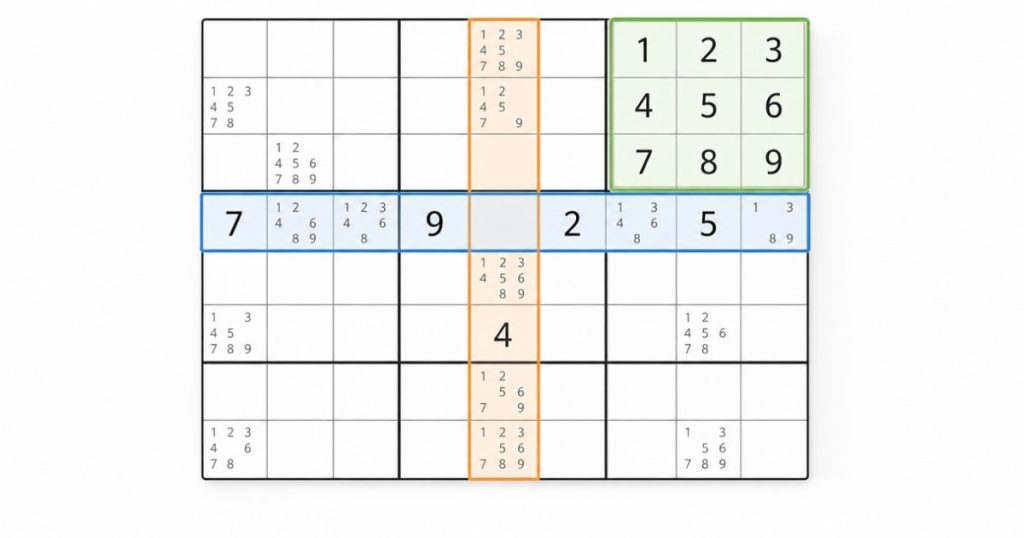
For each selected unit, ask two questions:
- Which numbers are missing?
- Where can each missing number legally go?
Prioritize the area where the missing-number list is short or where the surrounding rows, columns, and boxes eliminate many possible positions.
Find candidates by checking all three directions
To test an empty cell, write down the numbers that could fit there. Start with 1 through 9, then cross out any number already present in the cell’s row, column, or 3×3 box.
For example, suppose an empty cell is in a row containing 1, 4, 7, a column containing 2, 5, 8, and a box containing 3, 6. Together, those units contain every number from 1 to 8. The only remaining candidate is 9, so 9 is a safe placement.
The conclusion depends on all three checks. Seeing that 9 is missing from the row alone would not be enough.
Recognize naked singles and hidden singles
A naked single has one candidate
A naked single is an empty cell with only one legal candidate after you check its row, column, and box. This is the most direct opening move. Enter the number, then update the surrounding candidates because the placement affects three units at once.
A hidden single is the only position for a number
A hidden single appears when a number has only one possible position within a row, column, or box, even though the cell itself may still have several candidates.
For example, a 3×3 box may be missing 2, 5, and 9. If 2 can go in two cells, 5 can go in two cells, but 9 can go in only one cell, that cell must contain 9. The other candidates in the cell do not change the fact that 9 has nowhere else to go in the box.
Do not confuse a missing number with a forced number. It becomes forced only after the other cells in the same unit have been ruled out.
Use a repeatable first scan
A systematic scan keeps you from revisiting the same areas without purpose. Use this sequence during the first few minutes:
- Choose a row, column, or box with many filled numbers.
- List the digits missing from that unit.
- Test the empty cells against their rows, columns, and boxes.
- Place a naked single or hidden single if you find one.
- Immediately rescan the affected row, column, and box.
- Continue through the rest of the grid.
Every confirmed placement changes the puzzle. A number added to one box can remove that candidate from several cells in its intersecting rows and columns, often revealing the next move.
Use notes to turn possibilities into progress
If every empty cell has two or more possibilities, add small pencil marks rather than forcing a number. Notes turn a vague grid into a record of what has already been eliminated.

Keep the notes organized and update them after every confirmed placement. If you place a 6 in a cell, remove 6 from the notes in that cell’s row, column, and box. Stale notes can make an impossible move look valid and hide a newly created single.
A simple notation system is enough. You do not need to mark every theoretical possibility if that makes the grid difficult to read. Start with the most constrained cells and add candidates where they help you compare positions.
Scan one digit at a time when cell-by-cell scanning stalls
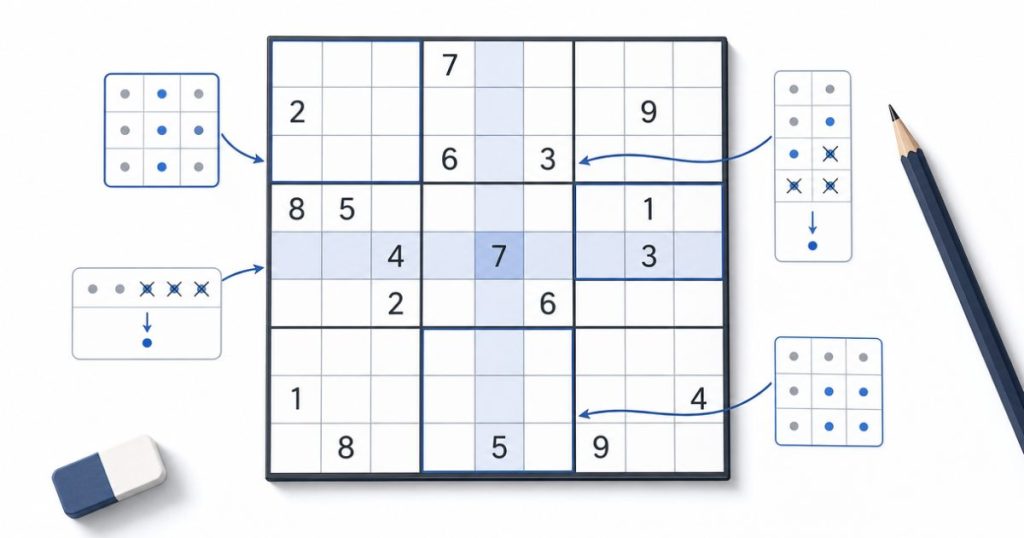
When a full pass through individual cells finds nothing, change your viewpoint. Pick one digit, such as 4, and examine each 3×3 box. In every box, identify the cells where 4 can legally appear. Then move to the next box or digit.
This digit-by-digit scan is useful for hidden singles because it asks a different question: not “What can go in this cell?” but “Where can this number go in this unit?” It can reveal a forced position that is easy to miss when you focus only on cells with short candidate lists.
If a complete scan still produces no placement, review your notes before trying a harder technique. Some puzzles do not offer an immediate single at the beginning, and advanced solving methods may eventually be needed. That is different from having a reason to guess.
Why guessing is usually the wrong first move
Guessing may produce a valid-looking number, but it gives you no logical reason to trust the resulting grid. One incorrect assumption can spread through several rows, columns, and boxes before the contradiction becomes visible. Finding and repairing that error is often harder than making steady progress from the start.
Use a simple decision rule: if a cell has multiple candidates and no unit restricts one of them to that position, leave it alone. Continue scanning, improve the notes, or move to a more advanced technique when the puzzle requires one.
Use hints and mistake checking as support
An online Sudoku game can make the opening process easier with notes, hints, and mistake checking. Notes help you record candidates without cluttering the grid. Mistake checking can warn you that an entry conflicts with the solution or with the puzzle’s rules, depending on how the feature works.
Use these tools to confirm or unblock your reasoning, not to replace it. Before taking a hint, identify the area you have already checked and the candidates you considered. Then use the smallest available assist, study why the suggested move works, and continue the scan yourself. A timer can track your session, but it should not pressure you into guessing.
Frequently Asked Questions
What should I look at first in an almost empty Sudoku grid?
Start with rows, columns, or 3×3 boxes containing the most filled numbers. Then check which missing digits have the fewest legal positions. This is a useful starting point, but it does not guarantee that the first move is there.
What if every empty Sudoku cell has several candidates?
Add organized notes, scan each unit for hidden singles, and try checking one digit at a time across the boxes. If no basic move appears after a complete scan, the puzzle may require an advanced technique.
How often should I update Sudoku notes?
Update them after every confirmed placement. Remove the placed digit from candidates in its row, column, and 3×3 box so your notes continue to reflect the current grid.
When should I use a Sudoku hint?
Use a hint after you have completed a careful scan and reviewed your notes. Treat it as a way to confirm or explain a logical move, rather than as a replacement for solving.
When a Sudoku grid looks empty, begin with the most constrained row, column, or box. Eliminate candidates using all three rules, then place only a naked single or hidden single. After every placement, update the notes and rescan the affected units.
If the first pass finds nothing, switch to a digit-by-digit search and review your pencil marks. The next move should be supported by the grid, not by a guess.