A stalled Sudoku Online position usually doesn’t mean the puzzle is impossible. More often, the next move is hidden by incomplete notes, an overlooked restriction, or an earlier entry that needs checking. Before you guess, pause and reset your approach.
Use this order: verify the grid, update candidates, search for singles, then look for pairs and box-line interactions. If no clear deduction appears, use a hint or restart deliberately instead of filling a cell at random.
Start with a four-step reset
When you can’t find the next number, stop scanning the entire grid without a plan. Work through this checklist:
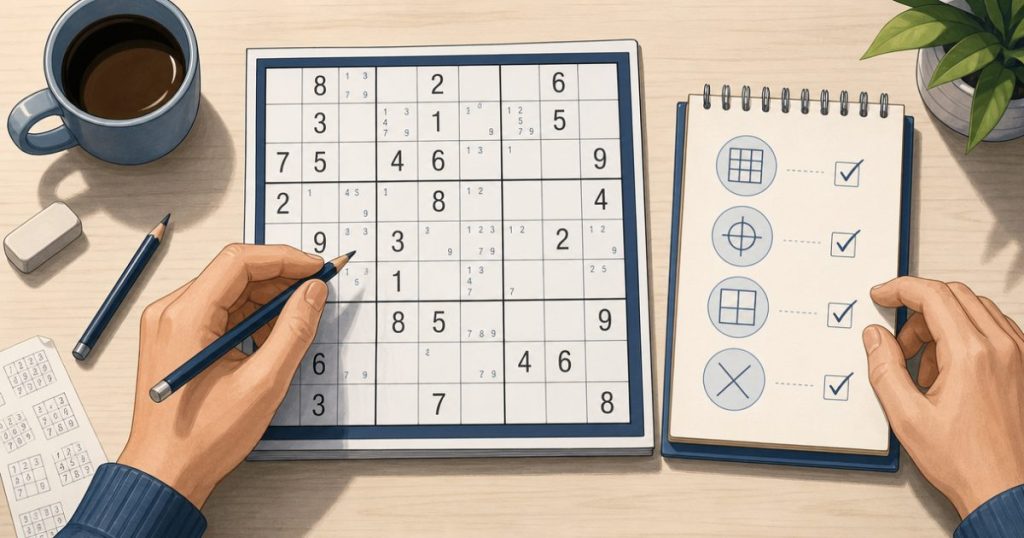
- Pause and inspect recent entries. Check the last few numbers you placed and make sure each one is allowed in its row, column, and 3×3 box.
- Complete or refresh your notes. Candidate marks should show every number that could legally fit in an empty cell, not just the numbers you notice first.
- Scan in a fixed order. Try boxes first, then rows, then columns. A repeatable order prevents you from checking the same familiar areas while missing another unit.
- Focus on one digit if the board feels crowded. Choose a number such as 5 and look for the places where 5 can still go. You don’t need to understand the whole puzzle at once.
After every confirmed placement, remove that number from the notes in the same row, column, and box. Stale candidates can make a solvable position look completely blocked.
Check whether an earlier entry caused the problem
A genuinely difficult position and an incorrectly filled position can look very similar. In both cases, obvious numbers disappear and candidate lists become unusually restrictive. The difference is that an error often creates a contradiction somewhere else on the board.
Start with the most recent entries and check each one against the three Sudoku rules:
- The number must appear only once in its row.
- The number must appear only once in its column.
- The number must appear only once in its 3×3 box.
A duplicate is an obvious warning, but not every mistake creates one immediately. An incorrect number may simply remove the only legal position for another digit later. If a row, column, or box has no possible place for a required number, review the entries that restricted it.
Online mistake checking can help identify an entry that conflicts with the puzzle, but it may not explain the deduction or reveal the first mistake in a chain. Treat it as a confirmation tool, not a substitute for reviewing your logic. If you’re still learning the basics, this guide to solving Sudoku step by step without guessing provides a broader recovery method.
Use notes to find naked and hidden singles
Candidate notes, also called pencil marks, turn an empty grid into a set of smaller logic problems. For each empty cell, list the numbers that aren’t already present in its row, column, or box. Then look for two types of singles.
Naked singles: one candidate in one cell
A naked single is an empty cell with only one remaining candidate. For example, suppose a cell is in a row containing 1, 2, 4, 6, 7, and 9. Its column rules out 3, and its box rules out 5. The only number left is 8, so that cell must be 8.
The number is forced by the cell itself. You don’t need to compare it with every other empty cell in the unit. Place it, then immediately update the affected row, column, and box.
Hidden singles: one position for a number
A hidden single occurs when a number has only one possible cell in a row, column, or box, even though that cell contains several candidates.
Imagine that a 3×3 box still needs the numbers 2, 5, and 8. Several cells may contain multiple notes, but if only one cell can legally contain 8, that cell must be 8. The 8 is “hidden” because the cell may also be marked with other candidates; the restriction becomes clear only when you examine the whole box.
To find hidden singles, choose one unit and inspect it digit by digit. Ask, “Where can 1 go? Where can 2 go?” Continue through the missing numbers. This is often more effective than staring at individual cells.
Scan boxes, rows, and columns systematically
Random scanning is one of the main reasons players miss an available move. A fixed scan order gives every part of the board equal attention.
Begin with the 3×3 boxes. For each box, identify its missing digits and check where each one can go based on the intersecting rows and columns. Then scan the rows from top to bottom, followed by the columns from left to right. Repeat the sequence after making a placement.
You can also scan by digit rather than by unit. Pick one missing number and trace its possible locations across all nine boxes. This reduces the task to one question: where can this digit legally appear?
The next number may not be near the area you were just solving. A placement in one box can eliminate a candidate in a distant row or column, so you don’t have to finish one region before moving elsewhere.
Look beyond singles: pairs and box-line interactions
If a careful scan reveals no naked or hidden single, try the next layer of basic deductions. These patterns don’t require guessing; they use the fact that every missing number must have a legal position.
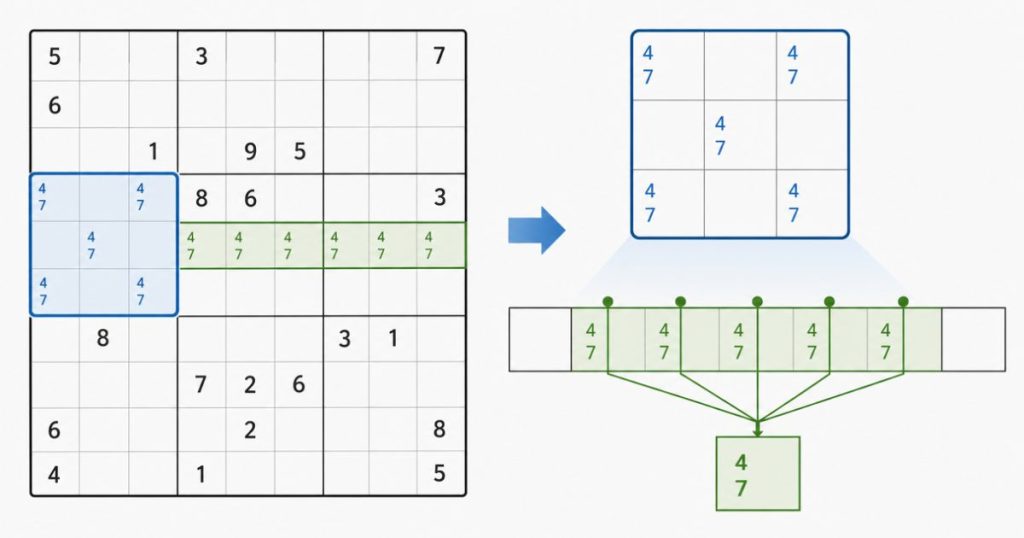
Naked pairs
A naked pair appears when two cells in the same row, column, or 3×3 box contain exactly the same two candidates, such as 2 and 7 in both cells. Those two numbers must occupy the pair in some order. Therefore, 2 and 7 can be removed from every other cell in that unit.
For example, if a row contains the notes {2,7} in two cells, no other cell in that row can contain 2 or 7. Removing those candidates may turn another cell into a single. The pair doesn’t tell you which cell is 2 and which is 7; it tells you where neither number can go elsewhere.
Box-line interactions
A box-line interaction happens when all possible positions for a digit inside a 3×3 box lie on the same row or column. If every possible 4 in a box is located in its top row, no other cell in that row outside the box can contain 4.
The same idea works in reverse. If all possible positions for a digit in a row fall inside one 3×3 box, remove that digit from the other cells in the box. This may expose a single or create a useful pair.
These patterns are easy to miss if your notes are incomplete, and they aren’t necessary for every stalled puzzle. Before searching for them, make sure the simpler candidates and singles are current.
Why guessing usually makes a stuck puzzle worse
Random guessing can produce a valid-looking number that is wrong. Because Sudoku errors may not create an immediate duplicate, you can make several placements before the contradiction appears. The result is a chain of false candidates and a much harder recovery.
Logical elimination is safer because every placement has a reason you can review. If a deduction later looks suspicious, you can return to the step that supported it. A guess gives you no reliable starting point for that review.
Some experienced players use controlled trial and error on very difficult puzzles, but that is different from choosing a number because it “looks likely.” If your goal is to learn, keep the main solve logical and use a hint or solution review when the required technique is beyond your current level.
When to use a hint, mistake check, or restart

Using help doesn’t undermine your progress. The useful question is whether the help shows you something you can understand and apply next time.
- Use mistake checking when you suspect a recent placement may be invalid. Remove or review the entry instead of continuing to build on it.
- Use a hint when your notes are accurate, you’ve completed a systematic scan, and you still can’t identify a deduction. Study why the suggested number belongs there before moving on.
- Restart the puzzle when the grid has become confusing because of several uncertain entries or outdated notes. A fresh attempt with a fixed scan routine can teach more than forcing a damaged position.
- Change difficulty if the puzzle repeatedly requires techniques you haven’t learned yet. Easier puzzles give you more chances to practise candidate updates and singles without timer pressure.
A timer and statistics can help you track progress, but they shouldn’t pressure you into guessing. If the game allows you to pause, use that time to review a difficult position. A slower solve with clear reasoning is more valuable than a faster solve built on unexplained guesses.
A repeatable routine for your next stalled puzzle
When you get stuck again, follow the same sequence:
- Check the last few placements for conflicts or unsupported guesses.
- Refresh candidates in the affected rows, columns, and boxes.
- Scan each 3×3 box, then each row, then each column.
- Search for naked singles and hidden singles.
- Choose one digit and trace its legal positions across the board.
- Look for naked pairs and box-line interactions.
- Only then use a hint, review the solution, or restart.
Keep notes accurate rather than merely abundant. Ten outdated candidates are less useful than a short, current list. With practice, you’ll learn to recognise whether the puzzle needs a deeper technique or is simply waiting for you to correct an earlier assumption.
Frequently Asked Questions
What should I check first when I cannot find a Sudoku move?
Check your recent entries for conflicts, refresh candidate notes, and scan boxes, rows, and columns in a fixed order. Look for singles before trying more advanced patterns.
How can I tell whether I made a mistake earlier?
Review recent placements and look for a duplicate or a unit where a required digit has no legal position. An online mistake check can confirm some invalid entries, but it may not identify the original error.
Should I guess when I am stuck on Sudoku?
Avoid random guessing, especially while learning. Guessing can create a chain of errors that is difficult to trace. Use candidates, elimination, a hint, or a controlled restart instead.
What if there are no singles?
Check for naked pairs and box-line interactions, then review whether your candidate notes are complete and current. Some puzzles require more advanced techniques, so a hint or solution review may be appropriate.
Getting stuck is usually a signal to change your process, not to guess. Verify the grid, update the notes, and scan the board in a consistent order before searching for more advanced patterns.
If no logical move appears after a careful review, use a hint or restart as a learning choice. The goal is to understand the restriction that reveals the next number, not just to finish the puzzle.