
A Sudoku candidate is a number that could legally go in an empty cell. It is possible, not confirmed. The candidate method means listing those possibilities, removing them as the grid provides more information, and placing a number only when logic shows that it must go there.
You can use pencil marks on paper or notes on an online Sudoku board. The key habit is to check each empty cell against its row, column, and 3×3 box, then keep those notes current after every confirmed placement.
How to calculate candidates for an empty cell
Every Sudoku cell can contain one number from 1 through 9. To calculate its candidates, start with all nine numbers and remove any number already present in:

- the cell’s row,
- the cell’s column, and
- the cell’s 3×3 box, also called a block.
A consistent scan helps you avoid missing a restriction: check the cell, then its row, column, and box. For example, suppose an empty cell has these numbers around it:
- Its row already contains 1, 4, and 8.
- Its column contains 2 and 7.
- Its 3×3 box contains 3 and 5.
Start with 1 2 3 4 5 6 7 8 9. Cross out 1, 4, and 8 because they appear in the row; cross out 2 and 7 because they appear in the column; and cross out 3 and 5 because they appear in the box. Only 6 remains, so 6 is the only candidate for that cell.
The order of candidates doesn’t matter. You might write them as 6, 9 or 9, 6. What matters is that every number in the list passes all three checks.
For a fuller explanation of legal placements and the three Sudoku constraints, see the simple guide to Sudoku rules.
A candidate list is not a solution
Notes show what is possible right now. They do not prove that a number belongs in the cell. A cell with candidates 2, 6, and 9 could contain any of them until another deduction removes two options or shows that one must be used.
This distinction matters when you use an online Sudoku game. A note may be incomplete, or it may become outdated after another number is placed. Don’t treat the only number you happened to write down as the answer unless you have checked that no other legal candidate remains.
Naked singles and hidden singles
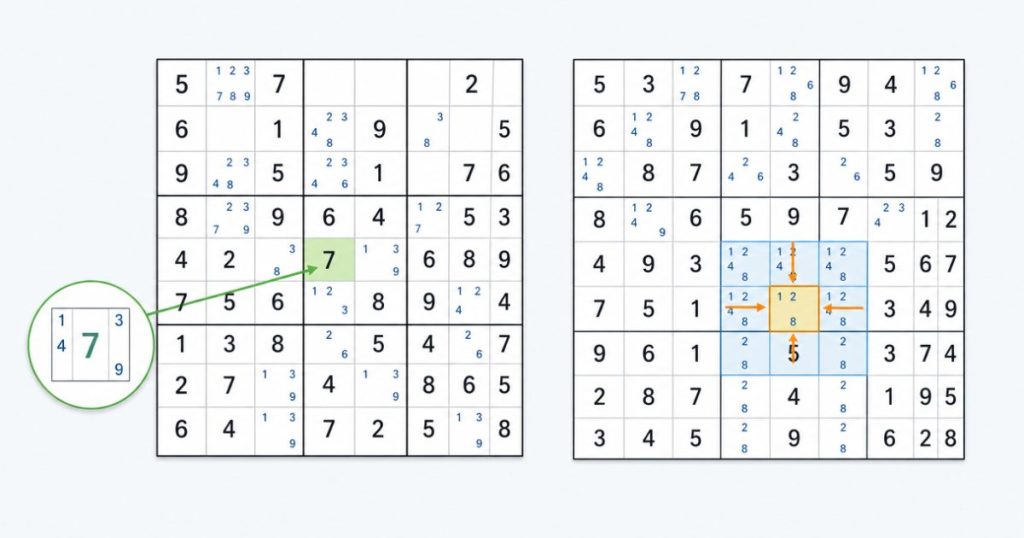
Finding a naked single
A naked single is an empty cell with only one remaining candidate. In the example above, the cell with only 6 left is a naked single. You can place 6 safely because every other number from 1 through 9 is ruled out by the row, column, or box.
Finding a hidden single
A hidden single works differently. The cell may still have several candidates, but one particular number has only one possible location in a unit—a row, column, or 3×3 box.
Imagine that three empty cells in a row have these notes:
- Cell A: 2, 5, 8
- Cell B: 1, 5, 7
- Cell C: 2, 3, 7
The number 8 appears only in Cell A. Because every row must contain an 8, Cell A must be 8, even though its candidate list also contains 2 and 5. That makes 8 a hidden single in the row.
To find hidden singles, check each number in a row, column, or box and ask: Which empty cells could still hold this number? If only one cell qualifies, place the number there.
Update notes after every confirmed number
Candidate solving is a repeating cycle:
- Write or review candidates for an empty cell.
- Look for a cell with one candidate.
- Scan each row, column, and box for a number with one possible location.
- Place only a confirmed number.
- Remove that number from notes in the same row, column, and box.
- Scan again for new singles.
For example, if you place 4 in a cell, check every note containing 4 in that cell’s row, column, and box. Remove 4 from those notes because Sudoku cannot repeat a number within a unit. Notes outside those three units are not affected.
Online notes make this process quicker, while mistake checking can warn you when a move conflicts with the puzzle. A hint can also point you toward progress, but try to understand which row, column, or box makes the placement logical instead of treating the hint as a guess.
What to do when every cell has several candidates
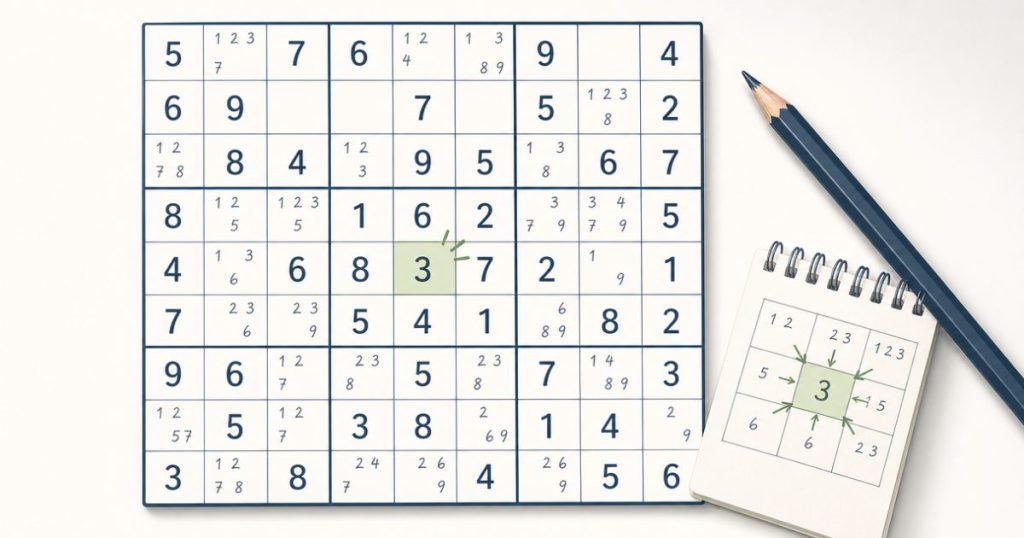
It’s normal to reach a point where no cell has a single candidate. First, check that you have updated all notes, then look for hidden singles across every row, column, and box. Candidate lists become more useful as the grid fills because each new number removes more possibilities.
A natural next step is the naked pair. If two cells in the same unit contain exactly the same two candidates, such as 3 and 8, those numbers must occupy those two cells in some order. You can remove 3 and 8 from the other candidate lists in that unit. This is still elimination, not guessing.
Don’t move to advanced patterns just because progress slows. Practice the basic method on an easy or medium puzzle first. If a harder grid still offers no clear deduction, check for a missed number or stale note. You can also follow a practical checklist for when you’re stuck.
A simple candidate checklist
- For an empty cell, start with numbers 1 through 9.
- Remove numbers already used in its row, column, or 3×3 box.
- Place a number only when one candidate remains or a unit gives that number one possible location.
- After every placement, update notes in the affected row, column, and box.
- Check for both naked singles and hidden singles.
- Use notes to organize possibilities, not to make random guesses.
- If progress stops, verify the notes before moving to a more advanced technique.
Frequently Asked Questions
How often should I update Sudoku notes?
Update them after every confirmed placement. Remove the new number from notes in the same row, column, and 3×3 box.
Can Sudoku candidates be written in any order?
Yes. The order doesn’t matter, as long as every listed number is still legal for the cell.
Are candidates the same as guesses?
No. A candidate is a logically possible number. Guessing means choosing between possibilities without proof, while candidate solving removes options until a placement is justified.
What should I do if every empty cell has multiple candidates?
Check for hidden singles, verify that your notes are current, and look for a simple pattern such as a naked pair. If nothing is clear, recheck the grid instead of guessing.
The candidate method turns a difficult Game Sudoku grid into a series of smaller logic checks. Remove the numbers blocked by an empty cell’s row, column, and box, then use the remaining notes to find singles and, when needed, simple pairs.
Keep your notes accurate and update them after every placement. A candidate narrows the choices; it becomes an answer only when the grid proves it.


