
The safest way to solve Sudoku is to treat every entry as a deduction. Don’t place a number because it looks likely. Scan the grid, list what each empty cell can accept, place only a value supported by the rules, and update the affected notes. Repeat that loop to make steady progress without guessing or throwing away the puzzle.
If you’re still learning the basic grid and rules, this beginner’s guide to playing Sudoku is a useful starting point. The method below takes you from the first scan to the final check.
Use the three Sudoku constraints together

A standard Classic Sudoku has a 9×9 grid divided into nine 3×3 boxes. Place the digits 1 through 9 so that each digit appears exactly once in every row, column, and box.
These three rules work as one system. A number may be missing from a row but still be impossible in a particular cell because it already appears in that cell’s column or box. Don’t check an empty cell in isolation. Ask:
- Which digits are missing from the row?
- Which of those digits are missing from the column?
- Which candidates also fit inside the 3×3 box?
The digits left after all three checks are the cell’s candidates.
Start with the most constrained parts of the grid
Begin with rows, columns, or boxes that already contain many numbers. They have fewer empty cells, so their missing digits are easier to identify. A systematic scan also helps you avoid overlooking a simple deduction.
- Scan each 3×3 box and note its missing digits.
- Check where those digits can go by looking at the matching rows and columns.
- Scan nearly complete rows and columns for cells with only one option.
- Record candidates in the remaining open cells using notes or pencil marks.
There’s no required scanning direction, but consistency matters. Move box by box or row by row so you can notice changes on the next pass.
Find certain numbers before doing anything complicated
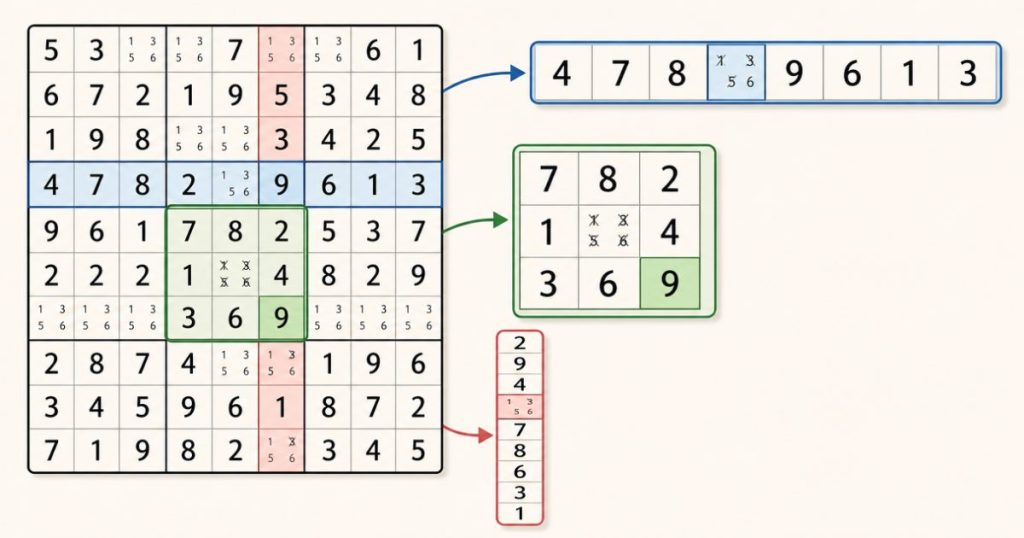
Naked singles
A naked single is an empty cell with only one candidate. For example, suppose a row is missing 2, 6, and 9. If the first empty cell cannot contain 2 or 9 because those digits already appear in its column or box, it must contain 6.
That number is certain because no other legal value remains. Place it, then remove the digit from the candidates in the same row, column, and box.
Hidden singles
A hidden single occurs when a digit has only one possible location within a unit, even though that cell may have several candidates.
Imagine a 3×3 box missing 1, 4, and 8. Several cells may accept 1, but after checking the relevant rows and columns, only one cell can accept 4. That cell must contain 4. The single is “hidden” because the cell’s candidate list is not limited to one value; the digit’s location within the box is unique.
Check for hidden singles in rows, columns, and boxes. They’re easy to miss if you only ask what a cell can contain instead of where a missing digit can go.
Maintain candidates after every confirmed number
Candidates, also called pencil marks or notes, are possible values, not confirmed numbers. They record what remains legal at a particular moment.
After placing a confirmed digit, immediately remove it from:
- Every empty cell in the same row
- Every empty cell in the same column
- Every empty cell in the same 3×3 box
For example, if you place 7 in the center box, erase 7 from every other open cell in that box. Then erase 7 from the rest of its row and column. One of those updates may create another naked single or reveal a hidden single.
Stale notes are a common cause of false deductions. Remove notes that are no longer possible. If you accidentally erase a valid candidate, restore it after checking the relevant row, column, and box.
Repeat the scan instead of expecting one pass to finish the puzzle
Sudoku solving is a cycle:
- Scan rows, columns, and boxes for missing digits.
- Write or review candidates.
- Place a naked or hidden single.
- Update every affected note.
- Scan the changed units again.
A confirmed number can create a deduction several cells away, so puzzles often require multiple passes. After each placement, check its row, column, and box before scanning the rest of the grid.
A compact record might look like this: r4c7 = 3, hidden single in column 7. Recording the reason for each move makes later review easier and helps separate logic from assumption.
When singles stop, eliminate candidates instead of guessing
It’s normal for every empty cell to have two or more candidates. That doesn’t mean the puzzle requires a guess. Look for relationships between candidates.

Locked candidates
A locked candidate appears when all possible locations for a digit within a box lie in the same row or column. If every possible 5 in a box is in its top row, 5 cannot appear elsewhere in that row outside the box. Remove 5 from those other cells.
The same idea works in reverse: if all possible locations for a digit in a row fall inside one box, remove that digit from the other cells in the box.
Naked pairs
A naked pair occurs when two cells in the same row, column, or box contain exactly the same two candidates, such as {2, 8} and {2, 8}. Those digits must occupy those two cells in some order. Remove 2 and 8 from every other candidate list in that unit.
A pair doesn’t tell you which cell is 2 or which is 8. It gives you an elimination, and that elimination may produce a single elsewhere.
Work through techniques in stages: master naked and hidden singles first, then use locked candidates and naked pairs. Leave more advanced patterns until these basic eliminations feel comfortable.
Use a contradiction to find an error, not to justify a guess
A contradiction is a warning that something in the current grid needs review. Common examples include:
- A row, column, or box contains the same confirmed digit twice.
- An empty cell has no candidates.
- A missing digit has no legal location in its row, column, or box.
First check for a missed candidate or an incorrectly updated note. If the notes are accurate, review your most recent confirmed placements. Undo the latest move that lacks a clear reason, return to the last reliable state, rebuild the affected candidates, and continue.
This is different from guessing. A trial assumption says, “This might be 4.” A logical deduction says, “Every other value is excluded,” or, “This is the only place for 4 in the unit.” If you explore a controlled branch as an advanced fallback, record the assumption clearly and undo the entire branch as soon as it creates a contradiction. Trial-and-error shouldn’t be the normal method.
Use online aids without giving up the reasoning
Notes, undo, mistake checking, hints, and a timer can make online Sudoku more practical. Use them to support the solving process:
- Notes: keep candidate lists visible and current.
- Undo: return to the last reliable logical state after an error.
- Mistake checking: use it as a warning, then identify why the move was wrong.
- Hints: ask for help when you’re stuck, but study the affected row, column, or box before moving on.
- Timer and statistics: track consistency and progress, not just speed.
A hint is most useful when it teaches you what to inspect next. If a tool supplies a number without explaining the deduction, verify it against all three Sudoku constraints yourself.
Verify the completed grid before you stop
Filling the last empty cell is not the same as checking the solution. Run a final verification:
- Check that every row contains 1 through 9 exactly once.
- Check that every column contains 1 through 9 exactly once.
- Check that all nine 3×3 boxes contain 1 through 9 exactly once.
- Look for duplicate digits, missing digits, or unresolved notes.
If every unit contains each digit once, the completed Classic Sudoku Online grid satisfies the rules. If a digital game reports a mistake despite an apparently complete grid, inspect the most recent entries and any cells entered without a recorded deduction.
Frequently Asked Questions
What should I look at first when starting a Sudoku?
Start with rows, columns, and 3×3 boxes that contain the most given numbers or the fewest empty cells. Identify their missing digits, then check which locations remain legal.
How do I know whether a Sudoku number is certain?
A number is certain when it is the only candidate left in a cell or the only possible location for that digit within a row, column, or box. If it merely seems likely, don’t place it.
Can I solve Sudoku without restarting?
Usually, yes. Use undo to return to the last reliable logical state after a contradiction, then rebuild the affected candidates. Restarting is optional for convenience, not a requirement for solving accurately.
When should I use a Sudoku hint?
Use a hint after checking singles and basic candidate eliminations. Treat it as a prompt to inspect the relevant row, column, or box, and verify the suggested move against the rules.
Remember the no-guess loop: scan, list candidates, place only a justified value, update the affected units, and scan again. When singles disappear, use eliminations such as locked candidates and naked pairs instead of placing a number because it seems plausible.
If the grid produces a contradiction, check your notes, undo the latest unsupported move, and rebuild from the last confirmed state. Accurate candidates and a consistent scan turn even a difficult puzzle into a series of verifiable decisions.


