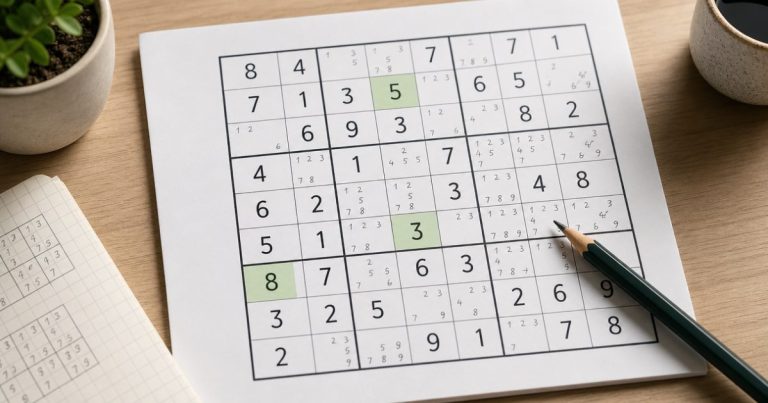
Getting better at Game Sudoku has less to do with memorizing advanced strategy names and more to do with making the basic process reliable. Scan the grid carefully, place only numbers you can justify, keep candidate notes current, and rescan after every useful move.
That approach improves accuracy first. Speed and harder puzzles can follow once your decisions become consistent. You may eventually need advanced techniques for very difficult grids, but most early progress comes from noticing information that was already available.
Start with the grid rules that control every move
A Classic Sudoku grid has nine rows, nine columns, and nine 3×3 boxes. The numbers 1 through 9 must appear exactly once in each row, column, and box. A number can go into an empty cell only if it does not already appear in any of those three related areas.
These rules are more than a reminder for beginners. They are the system you use to eliminate possibilities. For any empty cell, check:
- Which numbers are already in the cell’s row?
- Which numbers are already in its column?
- Which numbers are already in its 3×3 box?
The numbers left over are that cell’s candidates. A candidate is a possible value, not automatically the correct answer. A legal number may still be eliminated when another part of the puzzle provides more information. For a fuller explanation of legal moves and notes, see these simple Sudoku rules.
Use the same solving routine every time
A repeatable routine reduces rushed decisions and helps you notice information in a logical order.

- Scan the whole board. Look across rows, down columns, and through boxes for numbers that are almost complete. Do not focus on one small area too early.
- Find obvious placements. Look for empty cells with only one possible number and for numbers that have only one available position in a row, column, or box.
- Enter one certain number. Make the move only when the grid rules support it. Avoid placing a number because it “looks likely.”
- Rescan immediately. The new number changes candidates in its row, column, and box. It may also reveal a new placement elsewhere.
- Add or update notes where needed. If the next move is not obvious, record a small set of candidates in useful empty cells.
- Repeat before considering anything more advanced. Many puzzles provide several rounds of simple progress if you keep rescanning.
The most constrained area is often the best place to look next. A row with two empty cells, a box with three missing numbers, or a cell with only two candidates requires less searching than a wide-open part of the board.
Master naked singles and hidden singles first
Two basic patterns deserve regular practice because they appear in many puzzles.
Naked singles
A naked single is an empty cell with only one possible candidate. Suppose a cell’s row already contains 1, 2, 4, 6, and 8, its column contains 3 and 7, and its box contains 5. The only missing number from 1 through 9 is 9, so 9 must go in that cell.
You can find naked singles by checking an individual cell against its row, column, and box. They are easiest to spot when notes are clean, but a full candidate list is not always necessary. If a cell has only one legal value, place it and rescan.
Hidden singles
A hidden single is different. The cell may have several possible candidates, but one particular number has only one possible location within a row, column, or box.
For example, a 3×3 box may be missing 2, 5, and 8. Several cells could accept 2, but only one empty cell can accept 5 because the other cells in the box have 5 in their related rows or columns. That cell must contain 5, even if its notes also include other candidates.
To find hidden singles, choose one missing number and scan all empty cells in the relevant row, column, or box. This cross-checking process is sometimes called scanning or cross-hatching. It is often the move you miss when a puzzle appears stuck.
Use candidate notes as a filter, not a list of guesses
Notes, also called pencil marks, help you remember which numbers remain possible. They are most useful when you enter them selectively and maintain them after every placement.
For an empty cell, write only numbers that are absent from its row, column, and box. After placing a number, remove it from the notes of every related cell. If you place a 6, check the same row, column, and box and delete any candidate 6 there.
A simple before-and-after example looks like this:
- Before: a cell has candidates 2, 4, and 7.
- After placing 4 in the same column: remove 4 from that cell, leaving 2 and 7.
- After a later placement of 2 in its box: remove 2, leaving 7 as the certain value.
Notes become confusing when they are stale, incomplete, or entered without checking all three related areas. If the grid starts to feel cluttered, stop and refresh the candidates in one row, column, or box rather than adding more marks everywhere.
Know what to do when the next move is not obvious

Being stuck does not necessarily mean the puzzle requires an advanced strategy. First, put the timer aside and run a fresh scan.
- Check every 3×3 box for a hidden single.
- Look at rows or columns with only two or three empty cells.
- Review cells with notes and remove candidates made impossible by recent placements.
- Choose one missing number and trace where it can fit across a row, column, or box.
- Check whether an earlier entry was based on an assumption rather than a certainty.
If you still cannot find progress, use a hint as a learning prompt rather than immediately asking for the whole answer. Try to understand why the suggested move is forced. You can also use mistake checking to identify an incorrect entry, but do not let automatic feedback replace the reasoning process for every uncertain move.
For a more detailed checklist, read what to do when you are stuck on Sudoku.
Do not guess too early
Guessing can finish a puzzle, but it usually teaches less than a logical move. A wrong assumption may create several later errors, making it difficult to tell where the problem began. It also hides the useful question: which candidate did you fail to eliminate?
If you think you have reached a dead end, return to the last few placements. Look for a missed hidden single, an outdated note, or a number entered without checking the box. If an online puzzle marks a mistake, pause before correcting it and identify why the entry was impossible.
Some difficult puzzles do require techniques beyond singles. That does not mean you should guess during normal practice. If a grid is beyond your current level, study the point where your routine stopped, use a carefully explained hint, or choose a slightly easier puzzle.
Use online features to support learning
Digital Sudoku tools can make practice more informative when you use them deliberately.
- Hints: Use one after scanning carefully and wanting to learn what information you missed. Try to explain the hint before continuing.
- Mistake checking: Treat an incorrect-entry warning as feedback. Recheck the row, column, and box instead of simply replacing the number at random.
- Timer: Leave it off while learning a technique or rebuilding accuracy. Turn it on later to measure speed under familiar conditions.
- Statistics: Review completion times, mistakes, hints, and difficulty over several puzzles. One unusually easy or hard grid does not define your progress.
- Notes: Use them to reduce memory load, but keep them updated. More notes do not automatically mean better solving.
The goal is independent reasoning. If you use a hint on every difficult cell, you may complete more puzzles without improving your ability to recognize the next move.
Use difficulty levels as a training plan
Pick a level that makes you think but still lets you make logical progress. If you repeatedly guess, use several hints, or abandon puzzles early, the difficulty may be too high for focused practice. Move down a level temporarily and concentrate on scanning, singles, and clean notes.

Difficulty labels vary between platforms, so judge a puzzle by your experience rather than its name. A practical rotation might include:
- Comfortable puzzles to reinforce accurate scanning and note management.
- Challenging puzzles to test whether you can apply the same routine under pressure.
- Occasional harder puzzles to discover which patterns or decisions currently stop your progress.
You do not need to abandon easier puzzles once you move up. They are useful for practicing speed and accuracy without spending all your attention on a difficult deduction.
Separate accuracy, speed, and difficulty
Improvement has several dimensions, and they do not always rise together.
Accuracy means making fewer mistakes and relying less on guesses or corrections. Practice without a timer and aim to justify every placement.
Speed means reaching correct decisions more efficiently. Add timed sessions only after your basic routine feels reliable. Rushing before that point often produces careless entries and messy notes.
Difficulty means handling puzzles that offer fewer obvious placements or require more complex deductions. Moving to a harder level may slow your completion time at first, even while it represents real progress.
A useful record includes the puzzle difficulty, completion time, mistakes, hints, and whether you solved independently. Compare several puzzles at the same level instead of comparing one time with another from a different grid.
Build a short, deliberate practice habit
Regular, focused practice is more useful than opening puzzles randomly and repeating the same mistake. A simple session can look like this:
- Solve one comfortable puzzle without worrying about speed.
- Review any mistake, hint, or moment where you guessed.
- Solve one puzzle at your normal level using the same scan-and-rescan routine.
- Write down one specific issue, such as missing hidden singles or leaving stale candidates.
- Try a harder puzzle only if you can maintain logical play rather than guessing.
Occasionally repeat the process without a timer and compare your decisions with earlier sessions. Fewer mistakes, cleaner notes, fewer hints, and better performance at the same difficulty all count as improvement. A slower time on a harder puzzle does not necessarily mean you are getting worse.
Frequently Asked Questions
Can I get faster at Sudoku without learning advanced techniques?
Yes. Faster scanning, cleaner notes, and quicker recognition of naked and hidden singles can improve speed. Very difficult puzzles may eventually require advanced logic, but it is not necessary for early or steady progress.
How can I tell whether a Sudoku move is certain?
Check the cell’s row, column, and 3×3 box. If only one candidate remains, the move is a naked single. If a particular number has only one possible position in a row, column, or box, it is a hidden single.
Should I use a timer while practicing Sudoku?
Use an untimed session when learning or correcting habits. Add the timer after your solving process becomes reliable, and treat speed as one measure of progress rather than the only one.
What should I do if I keep needing hints?
Try an easier difficulty and review why each hint was needed. Look for missed singles, stale notes, or moves made without checking all three related areas. Use hints to understand deductions, not just to complete the puzzle.
The most reliable way to get better at Sudoku is to make simple habits dependable: scan all three units, place only certain numbers, keep candidates current, and rescan after every move. When you get stuck, investigate the grid before reaching for a guess.
Start your next session with one untimed puzzle and focus on accuracy. Once the process feels steady, add timed practice and gradually test a harder level. Advanced strategies can come later; careful observation will take you a long way first.