
In standard Classic Sudoku, you complete a 9×9 grid with the numbers 1 through 9. Every row, column, and 3×3 box must contain each number exactly once. You may place a number in an empty cell only if it does not duplicate a number in any of those three areas.
That makes a number a legal candidate, but not necessarily the correct answer. Sudoku is solved by using the clues and logic to determine which candidate belongs in each cell.
The basic Sudoku board
A standard Sudoku board has 81 cells arranged in nine rows and nine columns. Bold lines divide the grid into nine smaller 3×3 boxes.
- Cell: one square where a number can be placed.
- Row: a horizontal line of nine cells.
- Column: a vertical line of nine cells.
- 3×3 box: one of the nine outlined regions containing nine cells.
- Given clue: a number supplied at the start of the puzzle.
Some cells contain fixed clues, while others start empty. The goal is to fill every empty cell without breaking any of the three restrictions.
The three restrictions every number must follow
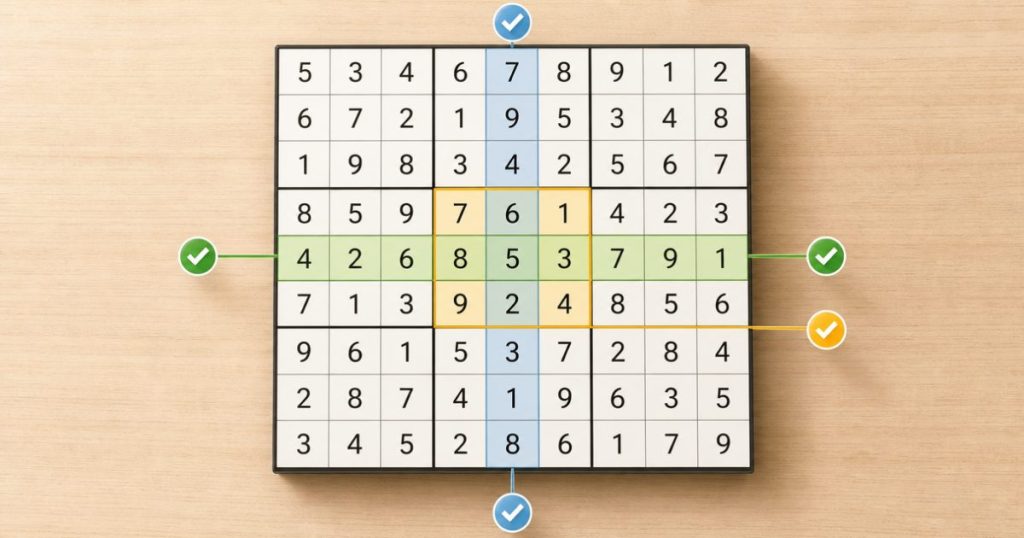
No repeated number in a row
Each completed row must contain the numbers 1 through 9 once each. If a row already contains a 6, you cannot place another 6 anywhere else in that row, even if the two cells are far apart.
No repeated number in a column
The same rule applies vertically. Each column must also contain 1 through 9 exactly once. If a 3 is already in the column connected to an empty cell, 3 is not a legal choice for that cell.
No repeated number in a 3×3 box
Each 3×3 box must contain the numbers 1 through 9 once each. A box is the outlined region of the grid, not just any group of nine nearby cells.
A number may appear in a different box on the same row or column. For example, two 8s can be in different 3×3 boxes as long as they are not in the same row or column. The no-duplicates rule is checked separately within each row, column, and box.
How to test a number in an empty cell
Before entering a number, check all three units connected to the cell:

- Look across the cell’s row.
- Look down its column.
- Check the 3×3 box containing it.
Suppose an empty cell is connected to a row containing 1, 2, 5, and 8; a column containing 3 and 7; and a box containing 6. Those numbers are ruled out. From 1 through 9, the remaining candidates are 4 and 9.
Both 4 and 9 are legal candidates at this stage, but you need more information to decide which one is correct. A number is not automatically the answer just because it does not repeat in the related row, column, or box.
Checking only the row is not enough. A 4 might be absent from the row but already appear in the cell’s column or 3×3 box, which would make it an illegal placement.
Legal moves are not always correct answers
Sudoku rules show which placements are possible. Logic determines which possible placement belongs in the solution.
If a cell can legally contain 2, 5, or 9, entering any of those numbers may avoid an immediate duplicate, but that does not prove the choice is right. A correct deduction usually comes from additional information, such as a number having only one possible cell in a row, column, or box, or another placement eliminating the alternatives.
Guessing is not against the rules. It is a solving approach that may require backtracking if an assumption later creates a contradiction. Many players prefer logic-based solving because each entry is supported by evidence and mistakes are easier to trace.
Given clues, entered numbers, and notes
Starting clues are part of the puzzle and cannot be changed. They provide the information used to deduce the rest of the grid. In an online game, clues are usually shown differently from numbers you enter.
A confirmed entry is a number you have placed in a cell as part of your working solution. It counts for the row, column, and box restrictions.
Notes, also called pencil marks, are possible numbers written small inside an empty cell. A note such as 4 means “4 might fit here,” not “4 has been placed here.” Notes do not count as numbers in the grid and do not create duplicates.
Remove a note when later information rules out that candidate. Enter a normal number when you are ready to treat it as a confirmed placement.
What online Sudoku tools change—and what they do not

Online Sudoku interfaces may highlight related cells, warn about duplicate numbers, offer hints, or let you check for mistakes. These are playing aids, not additional Sudoku rules.
A conflict warning usually indicates that an entry repeats a number in the same row, column, or box. It can help you spot a rule violation, but understanding why the placement conflicts is more useful than relying on the warning alone.
Hints may reveal information or suggest a move, depending on the game. Notes, timers, statistics, and mistake checking affect how you play, but they do not change the requirements for a valid completed grid. If an interface behaves differently, follow its displayed instructions while keeping the standard row, column, and box rules in mind.
Common questions about Sudoku rules
Can the same number appear twice in a row?
No. A completed row must contain 1 through 9 exactly once, so a repeated number makes the grid invalid.
Can a number repeat in different 3×3 boxes?
Yes, as long as the repeated numbers are not also in the same row or column. Each box has its own no-duplicates rule.
Can I change a number that was printed in the puzzle?
No. A given clue is fixed. You can change your own entries when correcting your work, but the original clues remain unchanged.
Do I have to fill the puzzle in a particular order?
No. You can solve cells in any order. Choose the move that the available clues support most clearly.
Classic Sudoku and Sudoku variants
The rules above apply to standard Classic Sudoku. Other versions may add constraints. Killer Sudoku, for example, includes outlined cages with additional sum and no-repeat requirements. Diagonal Sudoku may add restrictions along the two main diagonals.
Those extra rules do not replace the standard rules unless the variant says so. Check the instructions for the specific puzzle before playing.
Frequently Asked Questions
Is Sudoku a math game?
No. Sudoku uses numbers as symbols, but it does not require arithmetic. The challenge is arranging numbers according to row, column, and box restrictions.
Does every Sudoku puzzle have only one solution?
A properly designed standard Sudoku puzzle is generally intended to have one solution. The placement rules define valid grids, while the clues determine the intended completed grid.
Can a completed Sudoku grid contain two of the same number in different rows?
Yes. Each number appears once in every row, column, and 3×3 box, so the same number appears multiple times across the full 9×9 grid.
For every empty cell, check the row, column, and 3×3 box before entering a number. If the number is absent from all three, it is a legal candidate. Use further logic to confirm that it is the correct answer.
Keep original clues fixed, treat notes as possibilities rather than placed numbers, and use hints or mistake checks as assistance rather than as a substitute for the rules. That checklist is enough to start a Classic Sudoku puzzle correctly.


