Yes. A Sudoku with more given numbers can be harder than one with fewer clues, although the number of clues alone does not determine difficulty. What matters is how those clues are arranged, how much they restrict the grid, and which solving techniques are needed to make progress. A puzzle with 30 clues may fall into place quickly, while another with 40 clues can force a solver through long chains of deductions.
For players comparing puzzles on sudokuonline.mobi, this explains why the stated difficulty level is usually more useful than simply counting the starting numbers. Clue count is a visible feature, but puzzle structure is the hidden factor that controls the real challenge.
What is a clue in Sudoku?

A clue, also called a given, is a number placed in the grid before the puzzle begins. In a standard 9×9 Sudoku, the remaining cells must be filled with the numbers 1 through 9 so that every row, column, and 3×3 box contains each number exactly once.
More clues generally mean fewer empty cells and more immediate information. This often makes a puzzle easier, especially for beginners. A nearly completed row may reveal a missing number at once, and a filled box can quickly eliminate candidates from nearby cells.
However, clues do not all have the same value. One number may create several direct placements, while another may sit in a position that affects very little. A puzzle can therefore contain many clues without offering a clear next move.
Why clue count is not a reliable difficulty measure
Difficulty depends on the deductions required, not just on how much of the grid is already filled. Consider two simplified situations:
- Many useful clues: Several rows and boxes are nearly complete, so simple scanning produces a steady sequence of answers.
- Many unhelpful clues: The numbers are spread across the grid in a way that leaves few cells with a single possible value. The solver must compare candidates, find hidden patterns, or make deductions across multiple units.
Both puzzles may begin with a similar number of givens, but the second can feel substantially harder. The arrangement creates bottlenecks: areas where no obvious number can be placed until information is transferred from another part of the grid.
The reverse is also possible. A puzzle with relatively few clues may be easy if those clues are positioned to trigger many forced moves. Once one number is placed, it may unlock another, then another. This cascading effect is one reason sparse-looking puzzles are not automatically expert-level.
Clue distribution matters more than the total
Sudoku has three overlapping types of units: rows, columns, and boxes. A clue is valuable when it helps constrain several of these units at the same time. Its position can influence the usefulness of neighboring clues and determine whether a particular number can be eliminated from many cells.
For example, suppose a 3×3 box already contains eight different numbers. Its final empty cell is immediately solved, regardless of how many clues appear elsewhere. In another puzzle, the same number of givens may be distributed so that no box, row, or column is close to completion. The grid then provides less immediate guidance.
Balanced distribution can also increase difficulty. If every unit has a similar amount of information, there may be no obvious starting area. A solver has to search more carefully for interactions between units instead of repeatedly completing the most constrained row or box.
Useful clues and isolated clues
A clue has a stronger practical effect when it removes candidates from cells that are already under pressure. Clues grouped around a nearly complete unit often create simple progress. Isolated clues may technically reduce possibilities, but not enough to produce a visible placement.
This does not mean that clues should be packed into one corner. A valid Sudoku must still have a logical structure across the entire grid. The point is that two sets of givens with the same size can create very different networks of restrictions.
The solving techniques required are the real difficulty signal
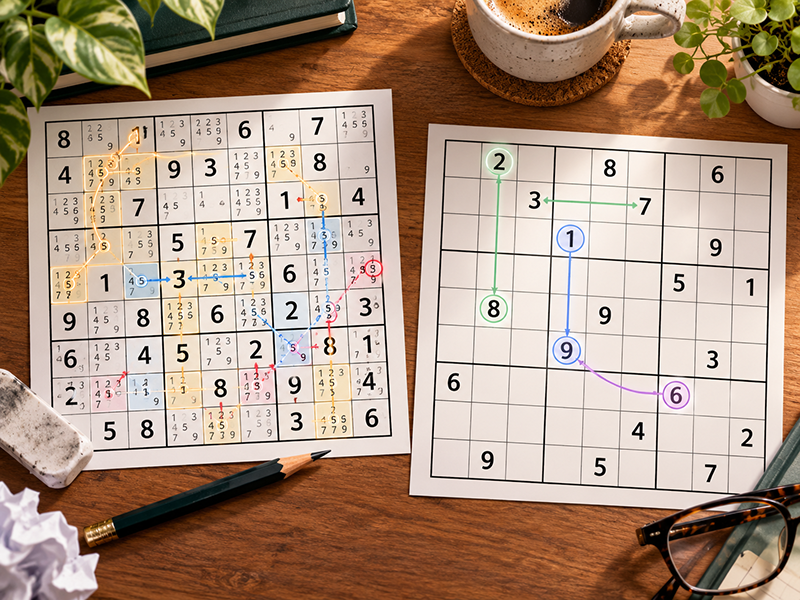
Sudoku difficulty is commonly described by the hardest technique needed to solve the puzzle without guessing. Beginner puzzles may be solved almost entirely with direct scanning. More advanced puzzles can require increasingly subtle relationships between candidates.
Naked singles
A naked single is a cell with only one possible number remaining. It is the most direct deduction: if a cell already sees eight different numbers in its row, column, and box, the missing number must go there.
Hidden singles
A hidden single occurs when a particular number can fit in only one cell within a row, column, or box, even though that cell has other candidates written in it. Finding these placements requires checking the whole unit rather than judging cells individually.
Pairs and triples
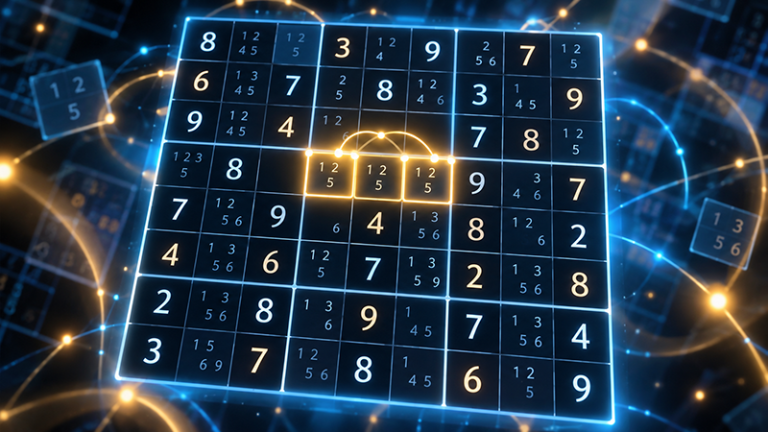
Pairs and triples use groups of cells to restrict candidates. If two cells in a unit contain exactly the same two candidates, those numbers must occupy those cells, so they can be removed from other cells in the unit. Similar logic applies to triples.
Locked candidates
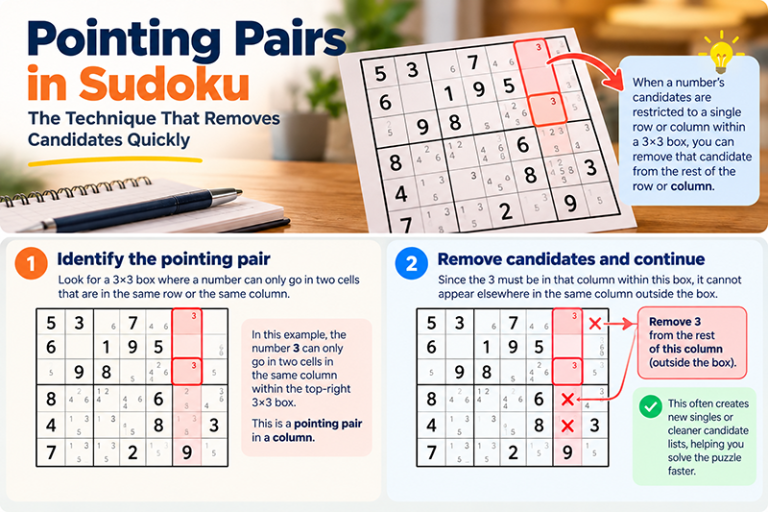
A locked candidate appears when all possible positions for a number within a box lie in the same row or column. That number can then be removed from the remaining cells in that row or column outside the box.
These techniques may be required in a puzzle with many clues if the givens are arranged to prevent simpler moves. Conversely, a puzzle with fewer clues may need only singles if its structure creates a long chain of straightforward placements.
Can adding clues make a puzzle harder?
Adding a clue to an existing Sudoku cannot make the underlying logical problem less constrained. It removes possibilities from the grid. In that mathematical sense, extra information does not make the solution set larger or the puzzle intrinsically more ambiguous.
But human solving difficulty can behave differently. A new clue can change the pattern of the puzzle and interrupt a familiar visual route. It may leave the grid with many nearly complete areas but no obvious continuation, making the puzzle feel harder than a sparser version that has a clean chain of deductions.
There is also an important distinction between adding a clue to a fixed puzzle and comparing two independently generated puzzles. If one puzzle is created by taking another and revealing an additional correct cell, the extra clue generally supplies useful information. If two puzzles are generated separately, the one with more clues may have a more difficult arrangement and may require stronger techniques.
Difficulty ratings normally refer to the whole puzzle, not to clue count in isolation. A generator may classify a puzzle by its required solving methods, the depth of its logical deductions, or a combination of structural tests.
Why fewer clues can sometimes feel easier

A puzzle with fewer givens often has more empty cells, but empty cells are not automatically difficult. If the clues establish a strong pattern, each solved number can affect several nearby units. The solver may experience a smooth sequence of forced moves.
Imagine a grid in which a missing number in one box can appear in only one position. That placement removes the number from a row, which reveals a hidden single in another box. The new placement then narrows a column. Although the puzzle began with relatively little information, the deductions reinforce one another.
Some sparse puzzles are also designed around clear, repeated patterns. Once a player recognizes the pattern, the remaining work may be routine. A denser puzzle with irregular candidate relationships can demand more attention despite having fewer blank cells.
How to judge difficulty while solving
Instead of counting givens, pay attention to the kind of work the puzzle asks you to do. These questions provide a better practical assessment:
- Can you make progress using only row, column, and box scans?
- Are naked or hidden singles appearing regularly?
- Do you need to record many candidates before finding a move?
- Are pairs, triples, or locked candidates necessary?
- Do you need to compare distant parts of the grid?
- Are you forced to examine long chains of consequences?
- Does the puzzle remain stalled even after all obvious candidates are marked?
A puzzle that repeatedly offers direct placements is usually approachable, even if it has few clues. A puzzle that leaves many candidates in place and requires interaction between multiple units is likely to be more advanced.
A simple way to compare two puzzles
If you want to compare difficulty fairly, use the same solving conditions for both puzzles. Do not rely only on how quickly the first few numbers appear.
- Start without guessing. Scan every row, column, and box for direct placements.
- Record candidates consistently. Missing notes can make an easy puzzle seem difficult, while careless notes can make a hard puzzle seem confusing.
- Track the strongest technique needed. Note whether singles were enough or whether you needed more advanced patterns.
- Count stalled stages. A puzzle that repeatedly reaches a dead end demands more searching and concentration.
- Check for errors. One incorrect entry can create artificial difficulty by removing the correct candidates from several units.
Time is useful, but it should not be the only measure. A player familiar with advanced techniques may finish a difficult puzzle quickly, while a beginner may take longer on a puzzle that is logically simple. Technique requirements offer a more transferable comparison.
What clue count can tell you
Clue count is still useful as a rough first impression. More givens usually mean fewer empty cells, more restrictions, and a greater chance that basic techniques will work. Fewer givens often suggest a need for more candidate tracking and deeper deductions.
It can also help identify unusual puzzles. A very sparse grid may be intended for experienced solvers, while a dense grid may be suitable for learning. Yet these are expectations, not guarantees. A well-designed difficulty label, supported by the techniques required, is more informative than a raw count.
Practical rule: treat clue count as a hint about the puzzle, not as its difficulty rating.
Tips for handling a puzzle that feels harder than expected
When a puzzle with many clues seems difficult, avoid assuming that you missed an obvious number. First check each box for hidden singles, then inspect rows and columns that contain several repeated candidate restrictions. A full candidate list can reveal a pair or locked candidate that is not visible during a quick scan.
If the grid becomes crowded with notes, focus on one number at a time. Ask where that number can go in each box and whether its possible positions are confined to one row or column. This reduces visual noise and often exposes a useful relationship.
When a sparse puzzle stalls, resist random guessing. Recheck earlier placements, especially numbers entered from memory rather than proven by elimination. A single mistake can make a logically solvable puzzle appear impossible. If the entries are correct, move from simple scans to candidate relationships rather than filling cells arbitrarily.
Sudoku becomes easier to assess once you separate visible information from logical information. The number of clues tells you how full the grid looks; the arrangement of those clues determines how effectively the grid communicates its solution. That is why a puzzle with more clues can absolutely be harder than one with fewer, and why the best measure of difficulty is the depth of reasoning required to solve it accurately.