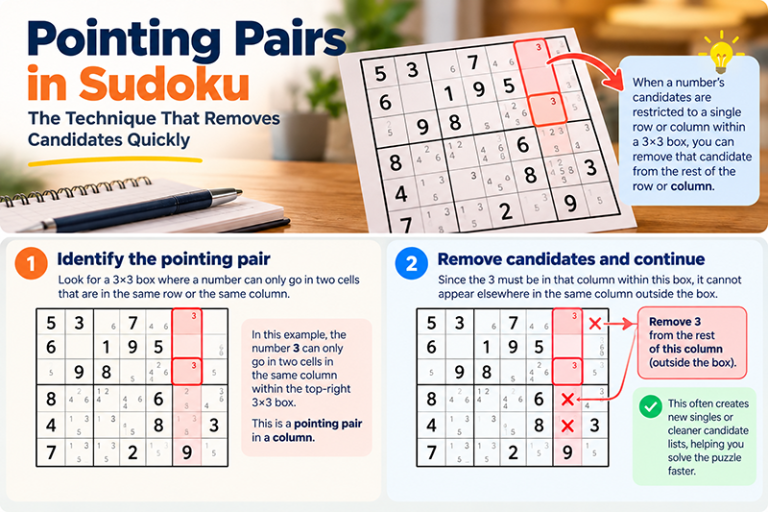
A triple is a Sudoku pattern in which three cells or three candidates are restricted to the same three digits. Finding one can remove those digits from other cells in the same row, column, or 3×3 box, often creating the next useful single or pair. On sudokuonline.mobi, notes and mistake checking can make it easier to mark candidates while you practice this technique, but the logic works exactly the same on paper.
What is a Sudoku triple?

A Sudoku triple involves three digits appearing in only three relevant cells within one unit. A unit is any row, column, or box. The three digits do not have to appear in every one of the three cells; they only need to be confined to those cells.
For example, suppose three cells in a row have these candidates:
- Cell A: 2, 5
- Cell B: 2, 7
- Cell C: 5, 7
Those cells contain exactly the digits 2, 5, and 7. Since each digit must be placed somewhere in the row, no other cell in that row can contain 2, 5, or 7. This is a naked triple.
Triples are useful because they reduce possibilities without requiring you to know the exact position of any one digit. Their strength comes from the fact that three cells collectively reserve three digits, even when each individual cell still has more than one candidate.
Naked triples
A naked triple occurs when three cells in one unit contain no more than three distinct candidates between them. The candidates may be distributed as two, two, and two; two, three, and three; or another combination, as long as the total set contains only three digits.
Consider this example in a column:
| Cell | Candidates |
|---|---|
| R2C4 | 1, 6 |
| R5C4 | 1, 9 |
| R8C4 | 6, 9 |
The three cells collectively contain only 1, 6, and 9. Therefore, 1, 6, and 9 must occupy those three cells in some order. Remove those candidates from every other unsolved cell in column 4.
You do not need to determine whether R2C4 is 1 or 6, for example. The elimination is valid because the three digits have already been confined to the three cells.
How to confirm a naked triple
- Choose a row, column, or box with several unsolved cells.
- Look for three cells whose combined candidate list contains exactly three digits.
- Check that the three cells all belong to the same unit.
- Remove those three digits from the other cells in that unit.
- Rescan the affected row, column, and boxes for singles or new patterns.
A common example is a set such as {3, 4}, {3, 8}, and {4, 8}. Another valid set is {2, 5}, {2, 5, 7}, and {5, 7}. In the second example, the combined candidates are still only 2, 5, and 7, so the three cells form a naked triple.
Hidden triples
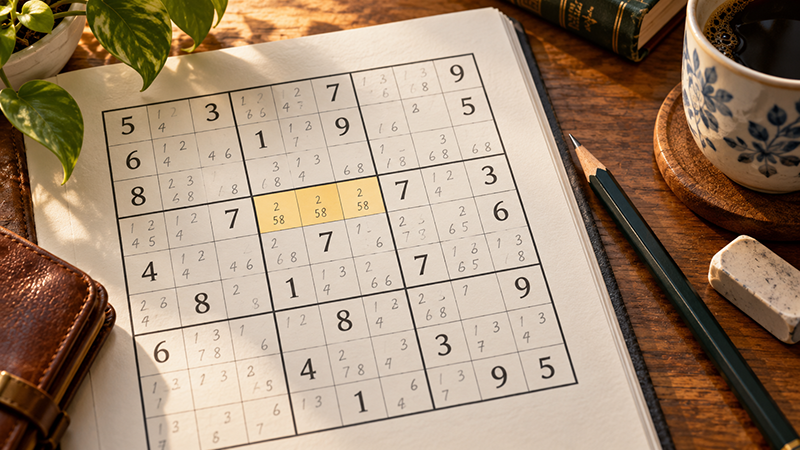
A hidden triple works in the opposite direction. Instead of starting with three cells that have limited candidates, you start with three digits that can appear only in three cells within a unit. Those cells may contain additional candidates, which can be removed.
Suppose a row has the following candidate locations:
- Digit 1 appears in cells A, C, and F.
- Digit 6 appears in cells A and F.
- Digit 8 appears in cells C and F.
The digits 1, 6, and 8 can be placed only in cells A, C, and F. They therefore form a hidden triple. If the candidate lists are:
- Cell A: 1, 4, 6
- Cell C: 1, 2, 8
- Cell F: 1, 3, 6, 8
Remove 4, 2, and 3. The cells become {1, 6}, {1, 8}, and {1, 6, 8}. The exact placements are still unknown, but the row has been significantly reduced.
Naked versus hidden triples
| Pattern | What you inspect first | What you eliminate |
|---|---|---|
| Naked triple | Three cells | The triple’s digits from other cells in the unit |
| Hidden triple | Three digits | Other candidates from the three cells |
The word “hidden” refers to the fact that the triple may be obscured by extra candidates in its cells. A hidden triple is often harder to spot because the three cells do not initially look restricted.
Why triples can unlock a difficult grid
Sudoku progress often depends on chain reactions. A triple may not place a digit immediately, but its eliminations can produce a naked single, a hidden single, a pair, or a pointing pattern.
For example, imagine that a naked triple removes 4 from one cell and 7 from another. One of those cells may then have only {2}, creating a solved value. That value removes another candidate from its row, column, and box. The original triple was not the final answer; it was the restriction that made the answer visible.
Triples are especially valuable when:
- Many cells contain two or three candidates but no obvious single exists.
- A row, column, or box has a dense group of pencil marks.
- You have already used singles, pairs, and box-line interactions.
- A puzzle appears stalled because candidates are spread across several cells.
A practical method for finding triples
1. Begin with crowded units
Do not scan the entire puzzle randomly. Choose a row, column, or box with several unsolved cells and detailed candidate notes. A unit with only two unsolved cells cannot contain a triple, while a nearly complete unit may make the pattern easier to see.
2. Check cells with two candidates first
Naked triples frequently include bivalue cells—cells with exactly two candidates. If two cells contain {2, 9} and {2, 6}, inspect nearby cells for a candidate set involving only 6 and 9. The third cell might be {6, 9} or {2, 6, 9}.
3. Count distinct digits, not total marks
This is the key test. Three cells may contain six, seven, or eight pencil marks, but they form a naked triple if only three different digits appear across all of them.
For instance, {1, 4}, {1, 4, 8}, and {4, 8} are a valid triple because their union is {1, 4, 8}. By contrast, {1, 4}, {1, 8}, and {4, 9} are not a triple because four distinct digits appear: 1, 4, 8, and 9.
4. Verify the unit boundary
All three cells must share a row, column, or box. Three cells that happen to be close together but do not belong to one common unit cannot form a standard triple. This simple check prevents many incorrect eliminations.
5. Scan after every elimination
Once you remove candidates, stop and rescan. Do not immediately search for a more complicated pattern. A triple often creates a simpler deduction, and solving the simpler deduction may reveal another triple elsewhere.
Worked example: a naked triple in a box
Imagine a 3×3 box with these unsolved cells:
| Cell | Candidates |
|---|---|
| R1C1 | 2, 4 |
| R1C2 | 2, 7 |
| R2C1 | 4, 7 |
| R2C2 | 1, 3, 5, 8 |
| R3C1 | 3, 5, 6 |
The first three cells contain only 2, 4, and 7. They form a naked triple inside the box. Remove 2, 4, and 7 from the other unsolved cells in that box. R2C2 is unaffected because it contains none of them. If another cell had candidates {4, 6}, it would become {6}; that would be a solved value.
Notice that the three cells do not need to be in the same row or column. A box is a complete unit, so the triple is valid within it. Any eliminations must stay within that box, although the resulting solved values can then affect their rows and columns.
Worked example: a hidden triple in a column
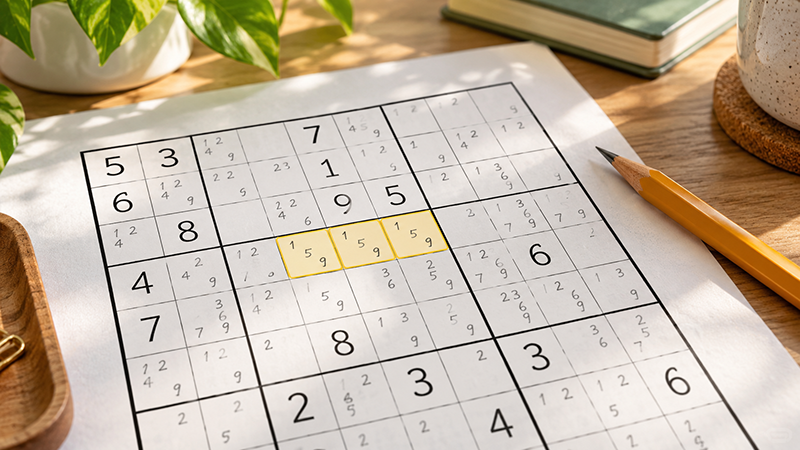
Suppose the candidate locations in a column are:
| Cell | Candidates |
|---|---|
| R1C5 | 1, 3, 6 |
| R3C5 | 2, 4, 6, 8 |
| R5C5 | 1, 5, 7 |
| R7C5 | 3, 5, 8, 9 |
| R9C5 | 2, 4, 7, 8 |
Here, digits 1, 6, and 3 are restricted to R1C5 and additional cells, so this particular list does not yet establish a hidden triple. The important lesson is to verify every digit’s complete set of locations rather than assuming a pattern from partial information.
Now suppose a complete scan shows that digits 1, 6, and 9 occur only in three cells—R1C5, R5C5, and R7C5. Even if those cells contain several other candidates, they form a hidden triple. Remove every candidate except 1, 6, and 9 from those three cells. The column is now much more constrained.
Common mistakes to avoid
Confusing a triple with three matching pairs
Three cells such as {1, 2}, {2, 3}, and {3, 4} are not a triple because four digits appear. The cells must collectively contain no more than three distinct candidates.
Eliminating candidates from the wrong unit
If the triple is found in a box, remove its digits only from other cells in that box. Do not remove them from the entire rows or columns crossing the box unless another valid technique justifies that step.
Using incomplete candidate lists
A missing candidate can create a false triple. Before applying an elimination, make sure the relevant notes are accurate. If you are solving manually, update candidates after every confirmed placement. In an online game, mistake checking can help identify invalid placements, but it does not replace careful candidate analysis.
Assuming the three digits must each appear once in each cell
They do not. A naked triple is about the group as a whole. The cells {1, 2}, {1, 3}, and {2, 3} are valid even though no cell contains all three digits.
When to look beyond triples
Triples are powerful, but they should not be the first technique you use in every situation. Start with direct singles and basic box-line interactions. If a simple candidate removal solves a cell, it is usually more efficient than searching for a hidden triple.
If a puzzle remains stalled after triples, the next possibilities may include quads, X-Wing patterns, or more advanced fish and chain techniques. However, recheck the grid before escalating. A missed single or incorrectly recorded candidate is more common than a genuinely unavoidable advanced pattern.
Practice strategy
To improve at triples, practice identifying the pattern before making any changes. Choose one unit, list the candidate locations, and ask two questions:
- Are there three cells whose combined candidates contain only three digits?
- Are there three digits whose possible locations are confined to three cells?
After finding a pattern, state the deduction clearly: “These three cells reserve these three digits, so those digits can be removed from the other cells in this unit.” This habit makes it easier to distinguish a valid triple from a tempting but incomplete pattern.
The main takeaway is simple: a triple does not need to reveal an immediate number. It narrows the legal arrangements in one unit, and that restriction is often enough to start a chain of progress. Keep candidate notes accurate, verify the shared unit, remove only what the pattern allows, and rescan the grid after each change.