When a Sudoku row or column contains a pair of matching candidates confined to the same box, those candidates can be removed from every other cell in that box. This pattern is called a pointing pair. It is one of the quickest advanced techniques to apply because it turns information from a line into a restriction on a 3×3 box.
You can use this technique while solving puzzles on sudokuonline.mobi, whether you are playing on a phone, tablet, or desktop. The key is to keep accurate notes and check how candidates are distributed, rather than looking only for completed numbers.
What Is a Pointing Pair?
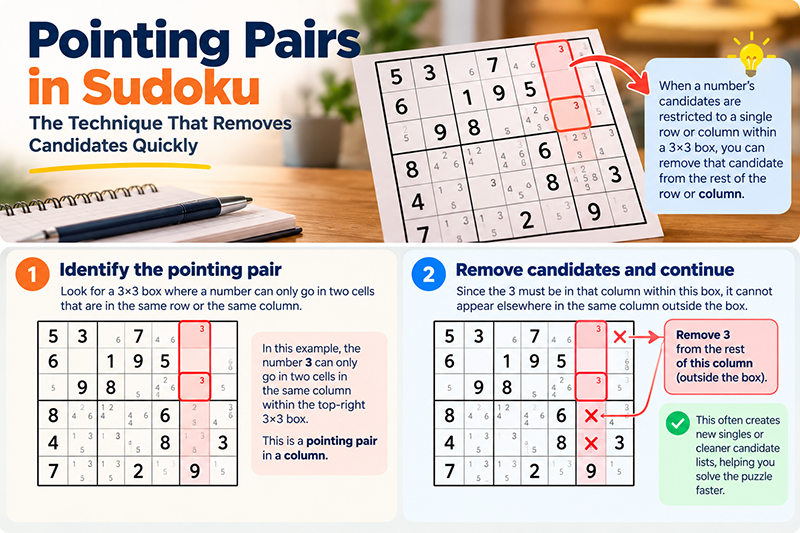
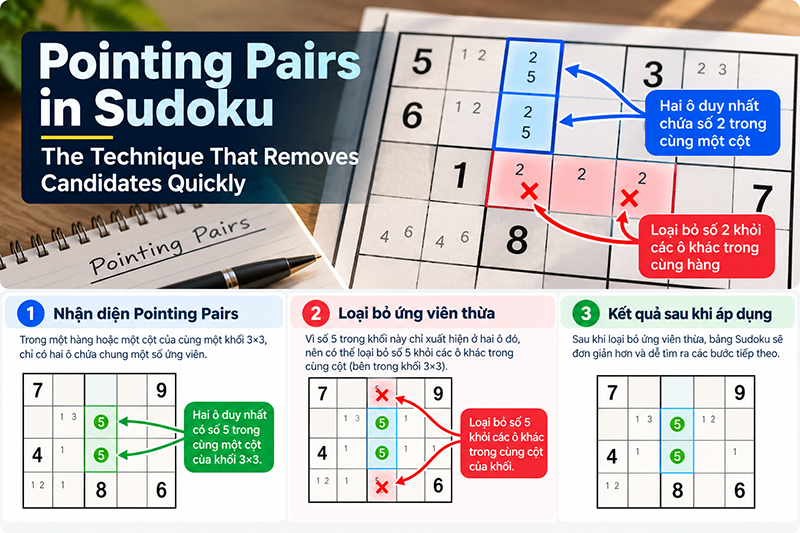
A pointing pair occurs when a candidate appears in exactly two cells within a box, and both of those cells lie in the same row or the same column. Because the candidate must be placed somewhere in that box, and the only available positions point along one line, the candidate cannot appear elsewhere in that line’s box.
For example, suppose a 3×3 box contains the candidate 7 in only two cells. If both cells are in the middle row of the box, then the 7 for that box must be placed somewhere in that row. As a result, any other 7 candidate outside the box but still in the same row can be removed.
The same logic works vertically:
- If the two candidates are in the same row, remove that candidate from the rest of the row outside the box.
- If the two candidates are in the same column, remove that candidate from the rest of the column outside the box.
The name comes from the candidates “pointing” from the box toward a row or column. A pointing pair is not a guess and does not tell you immediately which of the two cells is correct. It simply eliminates candidates elsewhere.
Why the Elimination Works
Every number from 1 through 9 must appear exactly once in each row, column, and 3×3 box. Consider a box where the number 4 can go in only two cells, and both cells belong to the same column.
Since the box needs a 4, one of those two cells must contain it. Both cells already occupy the same column, so placing a 4 in either one would prevent every other cell in that column from containing 4. Therefore, all other 4 candidates in that column, outside the box, are impossible.
The important detail is the phrase outside the box. You remove candidates from the rest of the shared row or column, but not from the two cells inside the box. Those two cells remain possible locations until another deduction resolves them.
How to Find a Pointing Pair
Use the following scan whenever you have filled several numbers and candidate notes are available.
- Choose a 3×3 box.
- Pick a candidate number that is still missing from that box.
- Check every empty cell in the box where that number could legally go.
- Count the possible locations for the number.
- If all of its locations lie in one row or one column, compare that line with the cells outside the box.
- Remove the candidate from other cells on that row or column.
A pointing pair requires at least two possible locations in the same line. If there is only one possible location, you have found a hidden single or a box-line placement, not a pointing pair. If there are three possible locations in the same line, the same elimination principle still works; many players call that a pointing triple.
A Simple Example
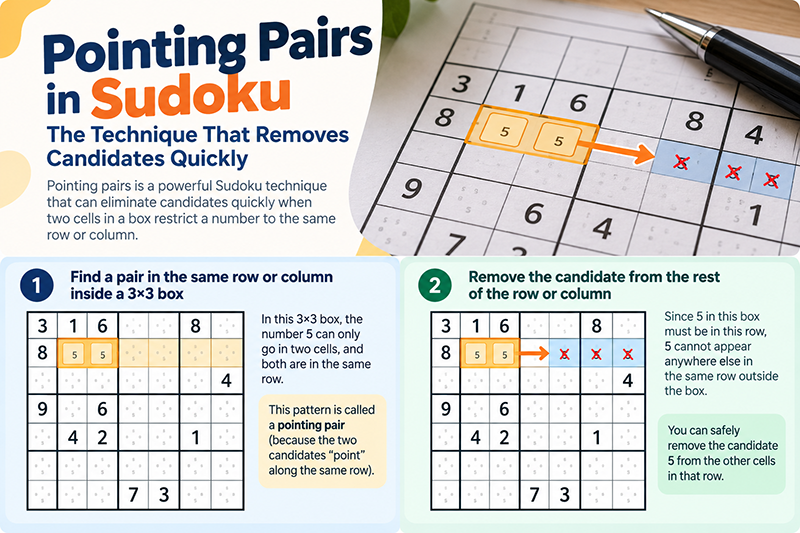
Imagine the top-left box covers rows 1–3 and columns 1–3. The candidate 5 appears in this box only at:
- Row 2, column 1
- Row 2, column 3
Both possible 5s are in row 2. The 5 for the top-left box must therefore be placed somewhere in row 2 within that box. It cannot be placed in row 2, column 4, column 5, column 6, column 7, column 8, or column 9.
If row 2 currently has a candidate 5 in column 5, remove it. If row 2 has another candidate 5 in column 8, remove that one as well. Do not remove the 5s at row 2, columns 1 and 3, because those are the two cells that created the pointing pair.
After the eliminations, one of several useful results may appear:
- A cell outside the box loses its last candidate and becomes a solved number.
- A hidden single appears in the row or another box.
- A new naked pair, locked candidate, or other pattern becomes visible.
Pointing Pair vs. Claiming Pair
Pointing pairs and claiming pairs are closely related, so they are often confused. The difference is the direction in which you begin the observation.
| Technique | Starting area | Candidate pattern | Elimination area |
|---|---|---|---|
| Pointing pair | 3×3 box | The candidate in the box is confined to one row or column | Rest of that row or column outside the box |
| Claiming pair | Row or column | The candidate in the line is confined to one box | Other cells in that box outside the line |
For a pointing pair, ask: Where can this number go in the box? If all locations line up, eliminate the number from the rest of that line.
For a claiming pair, ask: Where can this number go in the row or column? If all locations fall inside one box, eliminate the number from the rest of that box.
Both techniques use the same basic Sudoku rule, but recognizing the correct starting area helps you scan more efficiently.
Pointing Pair or Hidden Single?
Sometimes a box contains a candidate in only one cell. That is not a pointing pair. It is a hidden single because the number has just one legal position in the box.
There is also an important distinction between a pair of candidates and a pair of cells. In a pointing pair, you are tracking one number in two cells. The two cells do not need to contain the same complete candidate list. One cell might contain 2, 5, and 8, while the other contains 1 and 5. The pattern exists because 5 is restricted to those two cells, not because the cells have identical notes.
Pointing Pair or Naked Pair?
A naked pair consists of two cells in the same row, column, or box that contain the same two candidates and no others. Those two numbers can then be removed from other cells in that unit.
A pointing pair is different:
- It focuses on one candidate number.
- The two cells are inside the same 3×3 box.
- The cells share a row or column.
- The elimination takes place along that shared row or column, outside the box.
Learning to separate these patterns prevents incorrect deletions. Do not remove every candidate from the two cells simply because they are aligned. Only the restricted candidate is involved.
Common Mistakes to Avoid
Removing candidates inside the box
The pointing pair eliminates candidates from the shared line outside the box. The two original cells remain possible. Removing the candidate from either of them would destroy the very placement that supports the deduction.
Using cells from different rows or columns
If the candidate appears in two cells of a box but those cells are in different rows and different columns, there is no pointing pair. The candidate is not confined to one line, so no line-based elimination is justified.
Ignoring a third location
Before applying the technique, check the entire box. If the candidate appears in three cells and one of them is in another row or column, the candidate is not locked into a single line. A quick scan that misses one legal location can lead to an invalid move.
Confusing a possible pair with a solved pair
A pointing pair does not mean the two cells must contain different numbers, nor does it identify which cell contains the candidate. It only proves that the candidate belongs to that row or column within the box.
Deleting notes without checking the result
After making an elimination, inspect the affected row, column, and box. If a cell has only one candidate left, solve it and update the surrounding notes. Candidate work is most useful when every removal is followed by a fresh scan.
A Practical Scanning Routine
Rather than searching randomly, use a consistent routine:
- Start with the boxes that already contain many solved numbers.
- Choose one missing number and locate all of its candidates in that box.
- Look for alignment in a row or column.
- Apply the elimination only outside the box.
- Recheck the affected line for singles and pairs.
- Repeat with the next box or candidate.
You can also scan by number. For example, examine every box for the possible locations of 1, then every box for 2, and continue upward. This approach is especially useful when a puzzle has many notes but few obvious singles.
When solving without notes, pointing pairs are harder to spot because the pattern depends on knowing where a number cannot go. For medium and difficult puzzles, small candidate marks make the technique much more reliable. Keep them current: once a number is placed in a row, column, or box, remove that number from related notes before searching for patterns.
How Pointing Pairs Help With Harder Puzzles
A pointing pair may produce only one candidate removal, but that removal can have a large effect. Sudoku deductions often work as a chain:
Box restriction → line elimination → new single → updated candidates → further pattern.
This is why an apparently minor note can unlock a difficult position. The technique is also valuable because it uses only basic Sudoku rules. You do not need to guess, calculate probabilities, or test hypothetical branches. Every conclusion follows from the fact that a number has limited legal locations.
On easier puzzles, you may notice pointing pairs before needing them. On harder puzzles, they often appear after several rounds of singles and hidden singles have reduced the candidate lists. If the grid seems stuck, inspect each box for a number whose remaining candidates all point along one line.
Quick Checklist
- Are you starting from a 3×3 box?
- Are you tracking one specific candidate?
- Does that candidate appear only in two or three cells in the box?
- Are all those cells in the same row or column?
- Are you removing the candidate only from the rest of that line outside the box?
- Have you checked for new singles after the elimination?
Once this checklist becomes familiar, pointing pairs can be found in a few seconds. Look at the box, follow the candidate’s possible positions, and ask whether they all point in one direction. When they do, clear that candidate from the remainder of the line and continue solving.