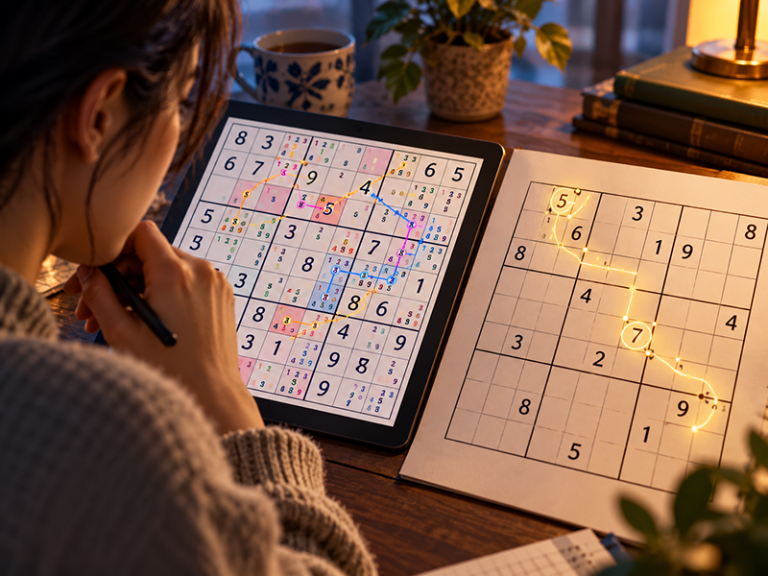
There is no single correct time for solving a Sudoku puzzle. A beginner may need 30 minutes for an easy grid, while an experienced player may finish it in only a few minutes. The useful question is whether your solving time matches the puzzle’s difficulty, your experience, and the way you play. On sudokuonline.mobi, players can use a timer, notes, hints, and mistake checking to measure progress without turning every puzzle into a race.
Typical Sudoku solving times by difficulty
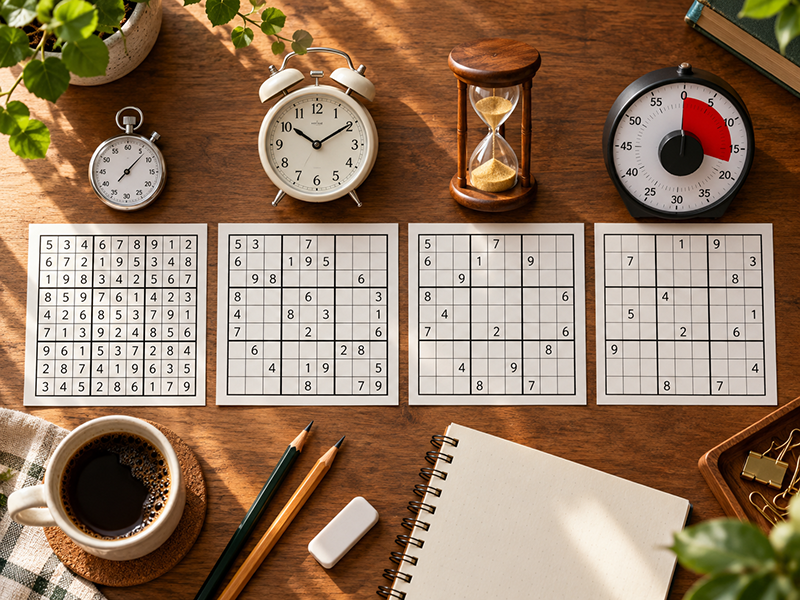
The following ranges are practical benchmarks for a standard 9×9 Sudoku. They are not strict limits. Puzzle design, solving method, and familiarity with common techniques can make a large difference.
| Difficulty | Beginner | Regular player | Experienced player |
|---|---|---|---|
| Easy | 15–30 minutes | 5–15 minutes | 2–5 minutes |
| Medium | 25–45 minutes | 10–25 minutes | 5–12 minutes |
| Hard | 40–90 minutes | 20–45 minutes | 10–25 minutes |
| Expert | 60 minutes or more | 30–90 minutes | 15–45 minutes |
These estimates assume that the player is solving logically rather than guessing. They also assume a normal game without long interruptions. On paper, writing and erasing candidates can take longer than entering numbers on a digital board. Conversely, a player may spend more time online because they are studying the puzzle carefully instead of trying to finish quickly.
How long should an easy Sudoku take?
An easy Sudoku often takes a beginner between 15 and 30 minutes. With regular practice, the same type of puzzle may take 5 to 15 minutes. Very experienced players can sometimes solve an easy grid in just a few minutes, especially when the clues create many immediate placements.
Easy puzzles usually contain plenty of direct information. You may find several empty cells where only one number is possible, known as a naked single. You can also scan rows, columns, and 3×3 boxes to find a number that has only one available position. These basic steps often allow the grid to progress without advanced patterns.
If an easy puzzle takes longer than expected, that does not necessarily indicate a problem. Common causes include failing to update notes, scanning the same area repeatedly, or overlooking a number already placed in a neighboring row or box. Instead of rushing, check each completed number against all three rules:
- Every row must contain the numbers 1 through 9 without repetition.
- Every column must contain the numbers 1 through 9 without repetition.
- Every 3×3 box must contain the numbers 1 through 9 without repetition.
How long should a medium Sudoku take?
A medium puzzle commonly takes a beginner 25 to 45 minutes and a regular player 10 to 25 minutes. Players who are comfortable with candidate notes and basic patterns may finish in under 15 minutes, although some medium grids are deliberately designed to require more careful reasoning.
Medium Sudoku puzzles may begin with simple singles but eventually require you to compare candidates across a unit. A hidden single occurs when a particular number can appear in only one cell within a row, column, or box, even though that cell contains several possible candidates. Recognizing hidden singles is often the first major improvement in solving speed.
At this level, avoid filling a cell simply because one option feels likely. A correct Sudoku move must be forced by the available information. If progress stops, add or review candidates rather than guessing. A few accurate notes can reveal a placement that is invisible when you rely only on visual scanning.
How long should a hard Sudoku take?
Hard puzzles may take 40 to 90 minutes for a beginner, 20 to 45 minutes for a regular player, and approximately 10 to 25 minutes for an experienced solver. Some hard grids can take much longer when they contain several tightly connected areas or require advanced candidate patterns.
The main difference is usually not the number of empty cells. A hard puzzle can have many clues and still be difficult if those clues do not produce immediate deductions. The important factor is the depth of reasoning needed to unlock the next stage.
Hard Sudoku often rewards a systematic routine:
- Fill all obvious naked singles.
- Search for hidden singles in every row, column, and box.
- Record candidates in cells that remain unresolved.
- Look for pairs or triples that restrict other cells in the same unit.
- Check whether a candidate is confined to one row or column inside a box.
- After every confirmed number, update nearby candidates and scan again.
A common time-wasting habit is continuing to scan randomly after basic methods stop working. When that happens, choose one number, such as 4, and track where it can go in each box. Focusing on one candidate at a time makes hidden restrictions easier to see.
How long should an expert Sudoku take?

Expert Sudoku can take an hour or more for a beginner, 30 to 90 minutes for a regular player, and 15 to 45 minutes for an advanced solver. Competitive players may solve some expert grids much faster, but their times usually reflect extensive practice, efficient notation, and familiarity with advanced techniques.
Expert does not always mean that the puzzle requires guessing. A well-constructed difficult grid should still have a logical path, but that path may involve techniques such as X-Wing, XY-Wing, coloring, chains, or carefully controlled trial-and-error analysis. These methods require more concentration because a single candidate can affect several distant parts of the board.
If an expert puzzle has taken an hour, the time has not been wasted. Difficult grids are useful for learning how deductions connect. Record the point where progress stopped, identify the technique that solved it, and try to recognize the same pattern in future puzzles. Improvement comes from understanding why a move is valid, not simply from seeing the final solution.
What affects your Sudoku solving time?
Experience and pattern recognition
Regular players do not calculate every possibility from the beginning. They quickly recognize familiar arrangements, such as a number restricted to one line or a pair of candidates locked inside two cells. This pattern recognition reduces the amount of writing and makes each scan more purposeful.
The puzzle’s actual design
Difficulty labels are useful but not perfectly standardized. One publisher’s medium puzzle may feel harder than another publisher’s hard puzzle. Some grids offer a smooth chain of deductions, while others create a long pause between two important placements. Judge a puzzle by the reasoning it requires rather than its label alone.
Paper versus digital play
Digital Sudoku can make entering numbers and candidates faster, especially when notes are easy to add or remove. Automatic mistake checking may also prevent an incorrect number from sending the entire solve in the wrong direction. Paper solving gives you more control over notation but requires careful erasing and checking.
Distractions and interruptions
A timer measures elapsed time, not pure solving ability. Phone notifications, breaks, conversation, and switching between tasks all affect the result. If you want a meaningful comparison, solve several puzzles under similar conditions rather than judging yourself from one unusually slow attempt.
Guessing and incorrect entries
Guessing can produce a fast completion, but it does not provide a reliable measure of solving skill. An incorrect assumption may also create a chain of errors that takes longer to repair than a careful deduction would have taken. For practice, use logic first and treat a hint as a way to learn, not merely as a shortcut.
How to measure Sudoku progress fairly
Speed is only one way to evaluate improvement. Track several results over time:
- Average time: Use a group of puzzles at the same difficulty instead of one isolated result.
- Error count: Fewer mistakes usually show better concentration and candidate management.
- Hint use: Needing fewer hints can indicate that your logical solving is becoming stronger.
- Technique level: Note whether you are using singles, pairs, intersections, or advanced patterns.
- Consistency: A stable 20-minute average is more meaningful than one very fast solve followed by several unfinished grids.
It is also useful to separate learning sessions from timed sessions. During a learning session, pause to inspect candidates and study why a deduction works. During a timed session, keep moving and apply techniques you already understand. Trying to learn a new pattern while chasing a personal record can make both activities frustrating.
Ways to solve Sudoku faster without guessing
Start with a consistent scan
Use the same order every time: scan rows, then columns, then boxes, or scan one number across the entire grid. A consistent routine reduces the chance of overlooking an easy placement. After entering a number, immediately recheck the affected row, column, and box.
Use candidates selectively
Notes are valuable when they are accurate. You do not need to fill every possible candidate in every cell from the start. Begin with cells that have two or three options, and remove candidates whenever a related number is placed. Outdated notes can be more confusing than no notes at all.
Look for intersections
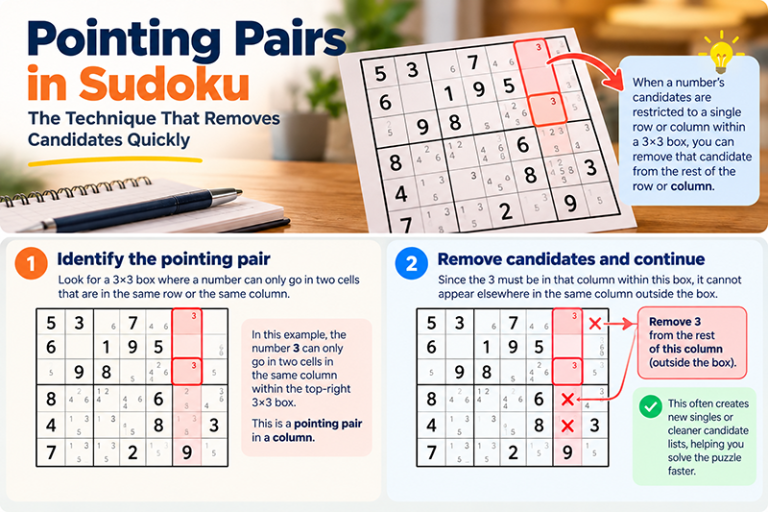
Suppose all possible positions for a 7 inside a 3×3 box lie in the same row. The 7 cannot appear elsewhere in that row outside the box. This is often called a pointing pair or pointing triple. The reverse situation, where a number’s candidates in a row are limited to one box, can restrict the rest of that box.
Recognize naked pairs
If two cells in a unit contain exactly the same two candidates, those candidates must occupy those two cells in some order. Remove both numbers from every other cell in that row, column, or box. This simple pattern can create a new single and restart progress.
Do not over-scan solved areas
Once a row or box has very few empty cells, inspect it briefly but then move to the areas affected by your latest placement. Efficient solving depends on directing attention toward change. Repeatedly checking a completed section rarely produces a new deduction.
When should you stop or change puzzles?
There is no benefit in forcing yourself to finish a puzzle when concentration has disappeared. If you have made no progress for several minutes, review candidates, try a different solving technique, or take a short break. Returning with fresh attention often reveals a restriction that was previously overlooked.
You can also change difficulty strategically. Beginners should spend enough time on easy and medium puzzles to build accuracy before moving to expert grids. Experienced players may alternate difficult puzzles with easier ones to maintain speed and confidence. The best level is the one that challenges your reasoning without making every move feel like a blind search.
A good personal benchmark is simple: solve accurately first, then improve speed gradually. An easy puzzle that takes 20 minutes with no mistakes may be more valuable than a five-minute solve based on guesses. As your scanning routine, candidate notation, and pattern recognition improve, your time will usually fall naturally. The goal is not to finish every Sudoku as quickly as possible, but to solve each grid with clear, repeatable logic.