A Swordfish is an advanced Sudoku pattern that clears a candidate from three whole lines at once. When one digit is trapped inside the same three columns across three rows, it cannot appear anywhere else in those columns — so you can erase it from every other cell there. This guide explains the pattern, shows how to spot it, and walks through a real, verified example.
What Is a Swordfish?
A Swordfish happens when a single digit, say 3, appears as a candidate in exactly three rows, and in each of those rows it sits in only two or three cells, all confined to the same three columns. The three rows between them need three copies of the digit, and each column can hold it only once. So the three columns are fully claimed by those three rows, and the digit cannot appear anywhere else in them.
It is the bigger cousin of the X-Wing: an X-Wing uses two rows and two columns, while a Swordfish uses three of each. The logic is identical — only the size changes. Like the X-Wing, a Swordfish works with rows and columns swapped: three columns confined to three rows lets you clear the digit from the rest of those rows.
A Swordfish does not place a digit directly. It removes candidates, and those removals often unlock the next single. That is why it matters on hard puzzles: one clean Swordfish can break open a grid that has resisted every simpler technique.
Swordfish vs. X-Wing at a Glance
| Pattern | Base lines | Cover lines | What you clear |
|---|---|---|---|
| X-Wing | 2 rows | 2 columns | The digit from the rest of the 2 columns |
| Swordfish | 3 rows | 3 columns | The digit from the rest of the 3 columns |
If you can spot an X-Wing, you already understand a Swordfish. The extra row only makes the pattern harder to see, because the three rows do not have to line up neatly: a row can hold the digit in two columns while another holds it in three, and some of the nine crossing cells can be empty.
How to Spot a Swordfish, Step by Step
Do not hunt for a Swordfish first. Use the singles, pairs and locked candidates first, and only start scanning for fish patterns when the puzzle stalls. A Swordfish is invisible without complete, accurate pencil marks, so fill in all candidates before you begin.
- Pick one digit. Work digit by digit. Good candidates are digits that appear often in your notes but have few possible cells in several rows.
- List the rows where the digit has two or three positions. Ignore rows where it is already placed, rows where it has only one position (that is a hidden single), and rows where it has four or more.
- Look for three rows whose columns combine to exactly three. Write the column numbers down for each row. If the union of the three rows is four or more columns, it is not a Swordfish.
- Check every candidate of the digit in those rows. One stray candidate in a fourth column breaks the pattern. If a row has the digit in a column outside the three, the fish is not valid.
- Clear the digit from the rest of the three columns. Remove it from every cell in those columns that is not in one of the three Swordfish rows. Then rescan: the removals frequently reveal a hidden single.
Start with the simplest shape, the 2-2-2 Swordfish, where each of the three rows holds the digit in exactly two cells. Once you can see that shape, the looser 2-2-3 and 2-3-3 variants become much easier to recognise.
Worked Example: A Real Swordfish on 3
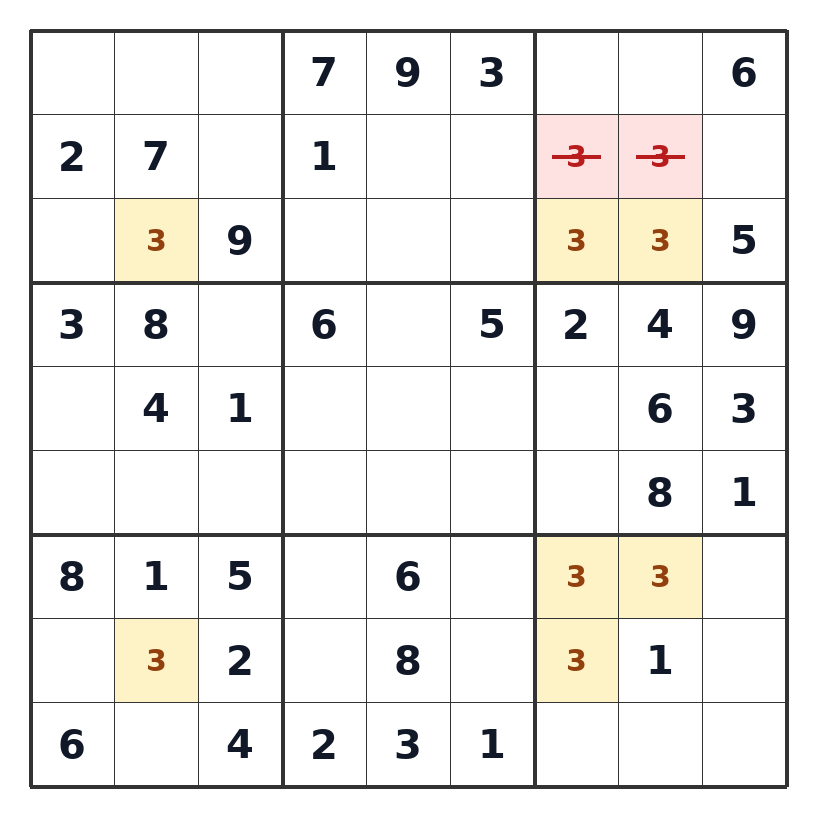
The puzzle below has 34 givens and exactly one solution. After filling in all candidates, look at the digit 3. In the image, the yellow cells hold the Swordfish pattern and the pink cells are the candidates it removes.
Check the digit 3 row by row:
- Row 3: 3 can go only in columns 2, 7 and 8. Column 1 is blocked by the 3 in row 4, column 4 is blocked by the 3 in row 1, column 6, column 5 is blocked by the 3 in row 9, column 5, and column 6 is blocked by the 3 in row 1, column 6.
- Row 7: 3 can go only in columns 7 and 8. Column 4 is blocked by the 3 in row 9, column 5 (same box), column 6 is blocked by the 3 in row 1, column 6, and column 9 is blocked by the 3 in row 5, column 9.
- Row 8: 3 can go only in columns 2 and 7. Column 1 is blocked by the 3 in row 4, column 1, column 4 is blocked by the 3 in row 9, column 5 (same box), column 6 is blocked by the 3 in row 1, column 6, and column 9 is blocked by the 3 in row 5, column 9.
All three rows reach only into columns 2, 7 and 8. Three rows need three 3s, and the three columns can take exactly three — one each. So no other cell in those columns can be 3. The only other 3s in columns 2, 7 and 8 are in row 2: row 2, column 7 (candidates 3, 4, 8, 9) and row 2, column 8 (candidates 3, 9). Remove 3 from both.
The payoff is immediate. Row 2, column 8 is left with a single candidate, 9 — a naked single created by the Swordfish. Place the 9, update the notes in row 2, column 8 and its box, and scan again: one elimination has already changed the puzzle.
Common Mistakes to Avoid
Clearing the wrong lines
A row-based Swordfish clears columns, not rows. If your pattern is built from three rows, the eliminations go in the three columns. Clearing the rows instead removes candidates that are still perfectly possible and can break the puzzle.
A fourth column sneaking in
Every candidate of the digit in each base row must sit inside the three columns. A single missed candidate in a fourth column invalidates the whole pattern, so check the full candidate list of the digit in all three rows before erasing anything.
Hunting for a Swordfish too early
Exhaust the singles, pairs and locked candidates first. An X-Wing is faster to find and its eliminations may create the very Swordfish you would otherwise hunt for. Searching for fish patterns on a grid full of unplaced singles wastes time and invites errors.
Expecting all nine crossings to hold the digit
Not every cell where the three rows meet the three columns needs to contain the digit. In the example above, only seven of the nine crossings hold a 3. The pattern works because the three rows are confined to the three columns, not because the 3×3 net is full.
Where to Practise
Swordfish patterns appear on the harder boards, so the best place to meet one is Expert Sudoku, and then Master Sudoku when Expert starts to feel routine. Keep full pencil marks switched on, work one digit at a time, and check the X-Wing first — the fish ladder is X-Wing, then Swordfish, then Jellyfish, and each step reuses the same counting idea.
Frequently Asked Questions
Is a Swordfish the same as an X-Wing?
No. An X-Wing uses two rows and two columns; a Swordfish uses three of each. Both trap one digit inside a set of lines and clear it from the rest of the crossing lines, but a Swordfish covers more of the grid and is harder to spot.
Do all nine cells of the 3×3 pattern need to hold the digit?
No. Each base row needs the digit in two or three of the three columns, so a Swordfish can have as few as six pattern cells. What matters is that no candidate of the digit in those rows falls outside the three columns.
How often does a Swordfish appear?
Rarely. Most hard puzzles are solved with singles, subsets and X-Wings, and a Swordfish is usually the step that appears only after those are exhausted. That rarity is exactly why it is worth learning: when a puzzle stalls at the hard level, the Swordfish is often the move that restarts it.