An XY-Wing is an advanced Sudoku pattern that removes a candidate from several cells at once, using just three cells with two candidates each. One cell, the pivot, shares a digit with each of the other two, and the two outer cells share a third digit between them. Whichever value the pivot takes, one outer cell must take that third digit — so any cell that sees both outer cells cannot hold it. This guide explains the pattern, shows how to spot it, and walks through a real, verified example.
What Is an XY-Wing?
An XY-Wing is made of three bivalue cells — cells with exactly two candidates — holding exactly three digits between them. Call the digits X, Y and Z:
- The pivot holds X and Y. It must share a row, column or box with each of the other two cells.
- Wing A holds X and Z, and shares a house with the pivot.
- Wing B holds Y and Z, and shares a house with the pivot.
If the pivot is X, wing A cannot be X, so wing A must be Z. If the pivot is Y, wing B cannot be Y, so wing B must be Z. Either way, one of the two wings is Z. That is the whole logic: any cell that can see both wings — shares a row, column or box with each of them — can never be Z, so Z can be erased from all such cells.
The two wings do not need to see each other. Only the pivot must see both wings, which is why the pattern often looks like a V or a bent line on the grid. The XY-Wing is also called the Y-Wing; the two names describe the same pattern. It sits on the same ladder as the X-Wing: the X-Wing traps one digit in two rows, while the XY-Wing chains three bivalue cells together.
XY-Wing vs. X-Wing and Swordfish at a Glance
| Pattern | Built from | Needs | What you clear |
|---|---|---|---|
| X-Wing | One digit in 2 rows and 2 columns | Candidate positions of one digit | That digit from the rest of the 2 columns |
| XY-Wing | Three bivalue cells, three digits | Full pencil marks in three cells | The shared digit Z from cells seeing both wings |
| Swordfish | One digit in 3 rows and 3 columns | Candidate positions of one digit | That digit from the rest of the 3 columns |
An XY-Wing does not place a digit directly. It removes candidates, and those removals often unlock the next single. That is why it matters on hard puzzles: one clean XY-Wing can restart a grid that has resisted every simpler technique. For the fish-pattern side of the same ladder, see our Swordfish guide.
How to Spot an XY-Wing, Step by Step
Do not hunt for an XY-Wing first. Use the singles, pairs and locked candidates first, and only start scanning for wings when the puzzle stalls. An XY-Wing is invisible without complete, accurate pencil marks, so fill in all candidates before you begin.
- List the bivalue cells. Look only at cells with exactly two candidates. A cell with three candidates cannot be part of an XY-Wing.
- Pick a pivot. Take one bivalue cell, say XY, and look at the bivalue cells it can see — same row, column or box.
- Find two wings with the right digits. You need one cell holding X and a new digit Z, and another holding Y and the same Z. If the shared digit differs between the two wings, there is no XY-Wing.
- Check that the pivot sees both wings. Each wing must share a house with the pivot. The wings do not need to see each other, and usually they do not.
- Find the cells that see both wings. Look for empty cells that share a house with wing A and also with wing B. Often they sit where a wing’s row meets the other wing’s column or box.
- Remove Z from those cells. Only Z — the digit shared by the two wings — can be removed. Then rescan: the removals frequently reveal a naked single.
A useful shortcut is to scan for the digit Z itself. Pick a digit that appears as a candidate in several bivalue cells, then check whether two of those cells connect through a third bivalue cell that holds one digit from each. The pivot is the cell that links them.
Worked Example: A Real XY-Wing on 1
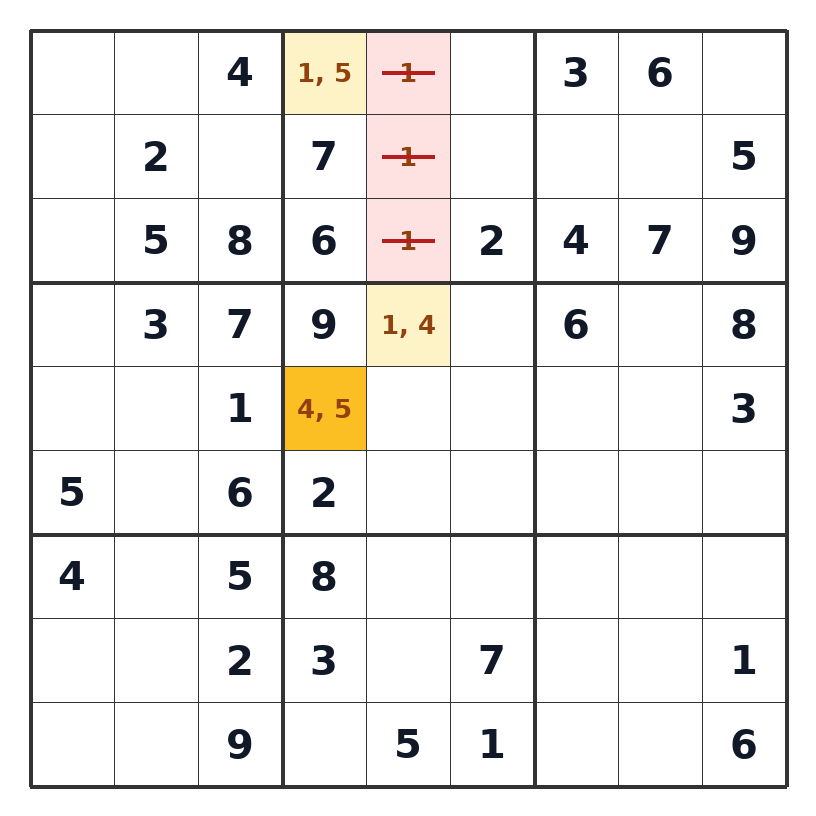
The puzzle below has 34 givens and exactly one solution. After filling in all candidates, three bivalue cells form an XY-Wing. In the image, the gold cell is the pivot, the yellow cells are the two wings, and the pink cells are the candidates the pattern removes.
| 4 | 3 | 6 | ||||||
| 2 | 7 | 5 | ||||||
| 5 | 8 | 6 | 2 | 4 | 7 | 9 | ||
| 3 | 7 | 9 | 6 | 8 | ||||
| 1 | 3 | |||||||
| 5 | 6 | 2 | ||||||
| 4 | 5 | 8 | ||||||
| 2 | 3 | 7 | 1 | |||||
| 9 | 5 | 1 | 6 |
Step 1: Check the three bivalue cells. The pivot is R5C4 with candidates {4, 5}: row 5 already holds 1 and 3, and column 4 already holds 2, 3, 6, 7, 8 and 9. Wing A is R4C5 with candidates {1, 4}: it shares the middle-centre box (rows 4–6, columns 4–6) with the pivot. Wing B is R1C4 with candidates {1, 5}: it shares column 4 with the pivot. The two wings do not see each other — R4C5 sits in the middle-centre box while R1C4 sits in the top-centre box — which is the classic V shape.
Step 2: Apply the either-or logic. Call X = 4, Y = 5 and Z = 1. If the pivot R5C4 is 4, wing A R4C5 cannot be 4, so it must be 1. If the pivot is 5, wing B R1C4 cannot be 5, so it must be 1. Either way, one of the two wings is 1. No cell that sees both wings can be 1.
Step 3: Remove 1 from the cells that see both wings. Three cells qualify, all in column 5:
| Cell | Before | After removing 1 | Why it sees both wings |
|---|---|---|---|
| R1C5 | 1, 8, 9 | 8, 9 | Row 1 with R1C4; column 5 with R4C5 |
| R2C5 | 1, 3, 4, 8, 9 | 3, 4, 8, 9 | Column 5 with R4C5; top-centre box with R1C4 |
| R3C5 | 1, 3 | 3 | Column 5 with R4C5; top-centre box with R1C4 |
The payoff is immediate. R3C5 is left with a single candidate, 3 — a naked single created by the XY-Wing. The completed grid confirms R3C5 = 3. Place the 3, update the notes in row 3, column 5 and the top-centre box, and scan again: one elimination has already changed the puzzle.
Common Mistakes to Avoid
The pivot does not see both wings
The most common error is building the chain from three bivalue cells where the pivot shares a house with only one wing. If either wing is invisible to the pivot, the either-or logic breaks: the pivot taking X no longer forces that wing to be Z, and nothing can be eliminated.
Using a cell with three candidates as a wing
All three cells must have exactly two candidates. A cell with candidates {1, 4, 7} is not a wing, even if it holds the right digits: if the pivot is 4, that cell could still be 7 instead of 1, so the elimination is not forced.
Eliminating the wrong digit
Only Z — the digit shared by the two wings and absent from the pivot — can be removed. Removing X or Y from the target cells is wrong: the pivot could still take that digit, and a wing could take the other one.
Clearing cells that see only one wing
An elimination is valid only for cells that see both wings. A cell that shares a house with wing A but not with wing B can still be Z, because wing B might be the one that takes Z. Check both connections before erasing anything.
Hunting for an XY-Wing too early
Exhaust the singles, pairs and locked candidates first. An X-Wing is faster to find, and its eliminations may create the very XY-Wing you would otherwise hunt for. Searching for wings on a grid full of unplaced singles wastes time and invites errors.
Where to Practise
XY-Wings appear on the harder boards, so the best place to meet one is Expert Sudoku. Keep full pencil marks switched on, work through the singles and pairs first, and check the X-Wing before hunting for wings — the ladder is X-Wing, then XY-Wing and Swordfish, and each step reuses the same idea of trapping a digit so it cannot appear somewhere else.
Frequently Asked Questions
Is an XY-Wing the same as a Y-Wing?
Yes. Y-Wing is the shorter name for the same three-cell pattern. Some guides call the pivot the base and the wings the pincers, but the structure — pivot XY, wings XZ and YZ — is identical.
Do the two wings need to see each other?
No. Only the pivot must see both wings. The wings usually do not share a house, and that is fine: the logic works because one wing or the other must be Z, regardless of whether they can see each other.
When should I look for an XY-Wing?
After the singles, pairs, triples, pointing pairs and box-line reduction are exhausted, and after checking for an X-Wing. On Hard puzzles an XY-Wing is uncommon; on Expert puzzles it is one of the standard moves that unblocks a stalled grid.
Can one XY-Wing remove more than one candidate?
Yes. Every cell that sees both wings loses Z, so a single XY-Wing can clear Z from several cells at once — three in the example above. Each removal can then trigger a new single, so always rescan the affected rows, columns and boxes.