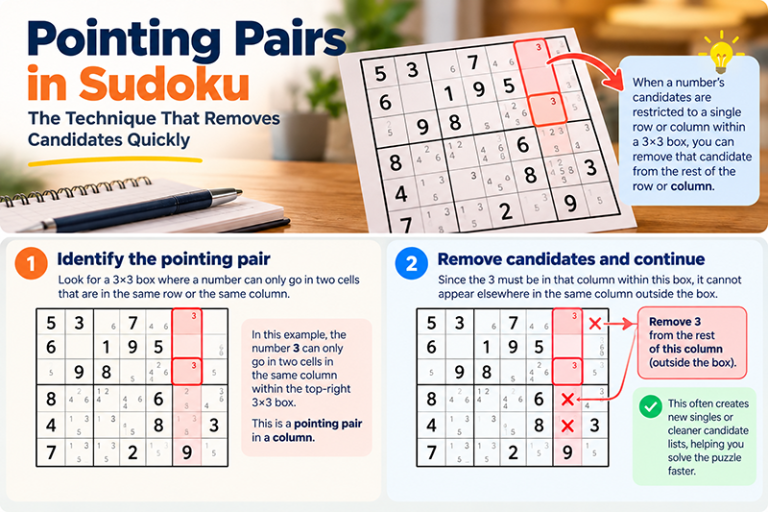
You’ve filled in the obvious numbers, checked every row and column, and looked for singles. Now your Sudoku grid seems stuck. Several cells have two or three possible numbers, but nothing looks certain enough to fill in.
This is where Box-Line Reduction can make a difference.
Box-Line Reduction is a Sudoku solving technique that helps you eliminate candidates by examining how a row or column overlaps with a 3×3 box. It doesn’t require guessing or complicated calculations. Instead, it uses information you already have to rule out numbers that cannot possibly fit.
Once you recognize the pattern, a difficult-looking puzzle can become much easier to manage.
In this guide, we’ll explain how Box-Line Reduction works, walk through practical examples, and show you when to use it while playing on SudokuOnline.mobi.
What Is Box-Line Reduction in Sudoku?
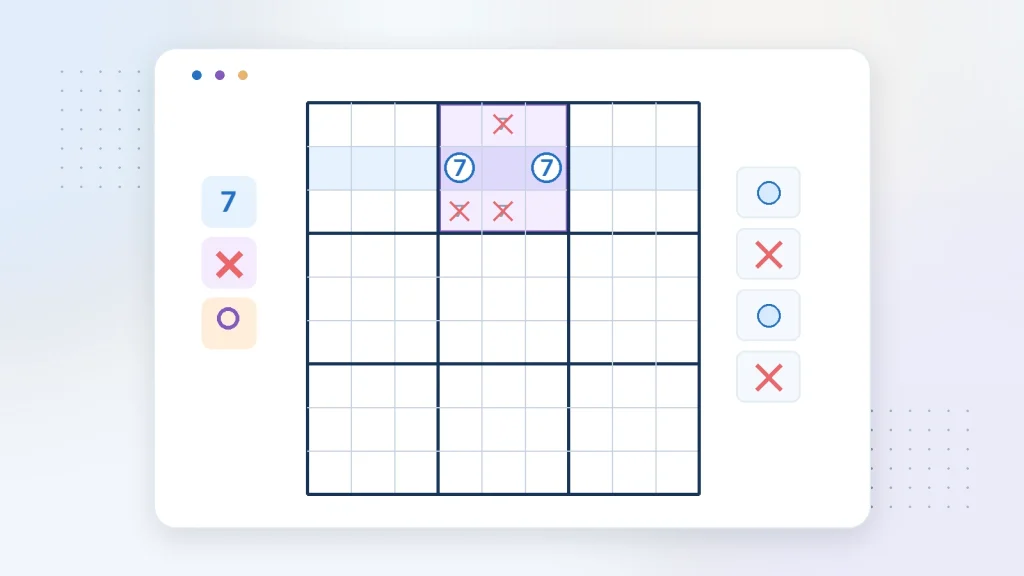
Box-Line Reduction is a technique used to eliminate candidates when all possible positions for a number in a row or column fall within the same 3×3 box.
Because every row and column must contain each digit exactly once, that number must be placed somewhere in the shared box.
As a result, you can remove the same candidate from other cells in that box, provided they are outside the row or column being examined.
This technique is also known as:
- Claiming Pairs
- Claiming Triples
- Locked Candidates Type 2
- Box/Line Interaction
Despite the different names, the underlying principle is the same.
Imagine that the number 6 can appear in only two cells of a particular row. Both cells happen to belong to the same 3×3 box.
You don’t yet know which of those two cells contains the 6. But you know that the row’s 6 must be somewhere inside that box.
Since a box can contain only one 6, every other cell in that box must exclude 6.
That’s the entire idea behind Box-Line Reduction.
It may seem like a small observation, but removing even one candidate can reveal a new single or unlock another solving technique.
Why Does Box-Line Reduction Work?
The logic comes directly from the three basic rules of standard Sudoku.
Every digit from 1 to 9 must appear exactly once in each row, each column, and each 3×3 box.
These restrictions overlap.
A cell belongs to one row, one column, and one box simultaneously. Information from one region can therefore restrict the possibilities in another.
Consider a row where the digit 7 is missing.
After checking the existing numbers, suppose you discover that 7 can only fit in two cells: R2C4 and R2C6.
Here, R stands for row and C stands for column.
Both cells are inside the top-middle box, which covers rows 1–3 and columns 4–6.
Since row 2 must contain a 7, one of these two cells must eventually hold it.
That means the top-middle box will receive its 7 in row 2.
Consequently, 7 cannot appear anywhere else in that box.
Notice what we haven’t done: we haven’t decided whether R2C4 or R2C6 contains the number.
We don’t need to.
Box-Line Reduction works by identifying where a number must be located within a region, even when its exact cell remains unknown.
Box-Line Reduction Example: Step by Step
Let’s work through a simple candidate example.
Suppose you’re solving a standard Sudoku puzzle, and you’re examining row 2.
The number 7 hasn’t been placed in that row yet.
After checking the row’s empty cells, you find that the only possible positions for 7 are:
R2C4 and R2C6.
Both are located in the top-middle 3×3 box.
Here’s an illustration showing only the relevant candidate 7 positions in that box.
| Column 4 | Column 5 | Column 6 | |
|---|---|---|---|
| Row 1 | — | 7 (remove) | — |
| Row 2 | 7 (keep) | — | 7 (keep) |
| Row 3 | 7 (remove) | 7 (remove) | — |
The table is a simplified candidate snapshot rather than a complete Sudoku grid. Dashes indicate cells where 7 is not currently a candidate.
Step 1: Identify the number missing from the row
Start with row 2.
You know that the row still needs a 7. Look through its empty cells and identify every place where 7 could legally go.
In this example, only R2C4 and R2C6 allow it.
The important detail is that there are no other possible locations for 7 anywhere else in row 2.
Step 2: Check whether the candidates share a box
Both R2C4 and R2C6 belong to the top-middle box.
That means the row has effectively reserved the digit 7 for this box.
One of those cells must be 7, even though you cannot yet tell which one.
Step 3: Remove 7 from other cells in the box
Because the box’s 7 must be in row 2, any candidate 7 elsewhere in that box is impossible.
You can therefore eliminate 7 from R1C5, R3C4, and R3C5.
Do not remove 7 from R2C4 or R2C6. These are the positions that make the deduction possible.
Step 4: Look for the next logical move
Suppose R1C5 originally contained the candidates {2,7}.
After removing 7, only 2 remains.
You can now place 2 in R1C5, assuming the candidate notes were complete and correct.
This is a typical example of how Box-Line Reduction helps you solve harder Sudoku puzzles.
The technique itself only removes candidates. However, those eliminations can immediately create a Naked Single, Hidden Single, or another useful pattern.
Worked Example: A Real Box-Line Reduction on 7
The examples above use simplified candidate snapshots. Here is the same pattern on a real puzzle — a 9×9 grid with 34 givens and a single unique solution. Work through it with the steps above and check every claim against the grid.
| 4 | 1 | 6 | 5 | |||||
| 5 | 3 | 1 | 8 | |||||
| 9 | 8 | 2 | 5 | 7 | ||||
| 2 | 3 | 7 | ||||||
| 9 | 5 | 2 | 6 | |||||
| 8 | 6 | |||||||
| 2 | 5 | |||||||
| 5 | 1 | 9 | 3 | |||||
| 3 | 9 | 2 | 8 | 4 | 7 |
Step 1: Find the digit and its positions in the row. Look at row 5. It still needs a 7, and only three empty cells in that row can hold it: R5C1, R5C2 and R5C3. The other empty cells in the row are ruled out: R5C5 is blocked because column 5 already has a 7 at R3C5, and R5C6 is blocked because column 6 already has a 7 at R4C6. (R5C4, R5C7, R5C8 and R5C9 are already filled with 9, 5, 2 and 6.)
The candidates in those three cells are: R5C1 {1, 7}, R5C2 {1, 3, 4, 7} and R5C3 {3, 4, 7}.
Step 2: Check whether the candidates share a box. All three cells belong to the middle-left box, which covers rows 4–6 and columns 1–3. Row 5 has therefore claimed the digit 7 for that box. One of R5C1, R5C2 or R5C3 must be 7, even though we cannot tell which one yet.
Step 3: Remove 7 from the rest of the box. The other cells in the middle-left box are R4C1 (already 2), R4C2 and R4C3 (neither can be 7, because row 4 already has a 7 at R4C6), R6C1, R6C2 and R6C3 (already 8). Only two cells lose a candidate:
| Column 1 | Column 2 | Column 3 | |
| Row 4 | 2 | — | — |
| Row 5 | 7 (keep) | 7 (keep) | 7 (keep) |
| Row 6 | 7 (remove) | 7 (remove) | 8 |
Dashes indicate cells where 7 is not currently a candidate.
- R6C1: {1, 7} → {1}. Removing 7 leaves a single candidate, so R6C1 is 1 — a Naked Single created directly by the Box-Line Reduction. The completed grid confirms R6C1 = 1.
- R6C2: {1, 3, 4, 7, 9} → {1, 3, 4, 9}. The cell is not solved yet, but it is one candidate closer, and the 7 is now confined to row 5 of this box.
Step 4: Keep going. After placing 1 in R6C1, rescan its row, column and box before looking for the next pattern — the new 1 removes candidates from row 6, column 1 and the middle-left box, which is often where the next single appears. Box-Line Reduction rarely finishes a puzzle on its own; its value is exactly this kind of chain reaction.
Want to practise the pattern on a live board? Try a Hard Sudoku puzzle, where locked candidates appear regularly once the easy singles run out.
How to Spot Box-Line Reduction Quickly
Recognizing Box-Line Reduction becomes much easier once you develop a consistent scanning routine.
Begin by examining a row or column with several filled numbers. Fewer empty cells generally make candidate patterns easier to inspect.
Choose a digit that is still missing from that line.
Rather than looking at every candidate simultaneously, focus on that one number and check where it can legally appear.
If all possible positions fall inside the same 3×3 box, you’ve found a potential Box-Line Reduction.
Then check the rest of that box.
If the same digit appears as a candidate in cells outside your selected row or column, those candidates can be eliminated.
A useful question to keep in mind is:
Does this row or column force a number into one particular box?
If the answer is yes, inspect that box for eliminations.
There is one important distinction. If the digit has only one possible location in the entire row or column, you’ve found a Hidden Single rather than a claiming pair or triple. You can place that number directly.
Box-Line Reduction becomes especially useful when two or three possible positions remain and all of them are inside the same box.
Claiming Pairs and Claiming Triples
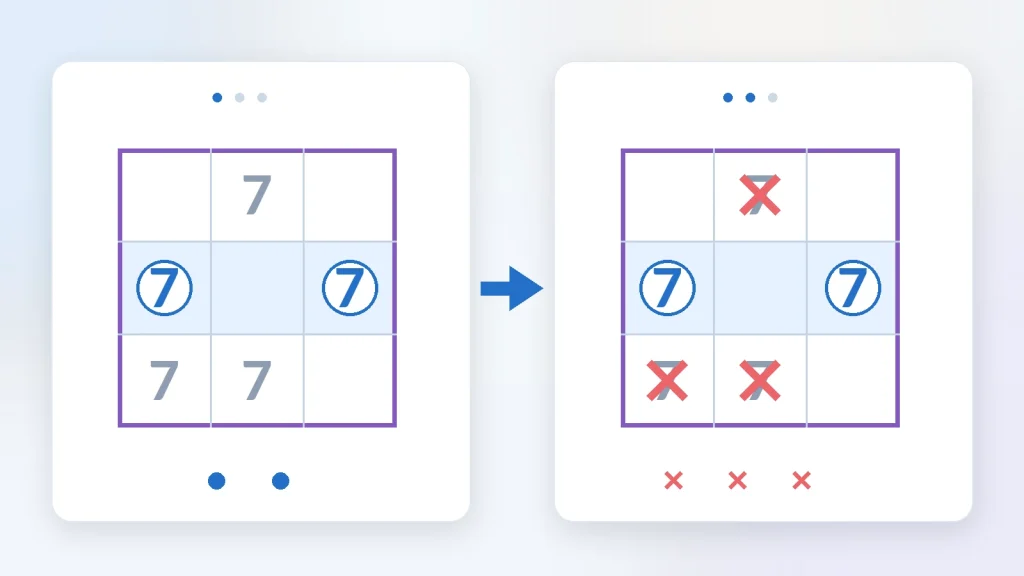
The names Claiming Pair and Claiming Triple describe how many possible positions remain for a digit.
Claiming Pair
A Claiming Pair occurs when a number has exactly two possible positions within a row or column, and both positions belong to the same box.
For example, suppose the number 4 can only appear in R5C7 and R5C9 within row 5.
Both positions belong to the middle-right box.
Therefore, the digit 4 must appear somewhere in row 5 of that box.
Every candidate 4 elsewhere in that box, outside row 5, can be removed.
The two possible cells do not need to be adjacent. They simply need to share the same box.
Claiming Triple
A Claiming Triple follows the same principle but involves three possible positions.
Imagine that the number 9 can only appear in R4C4, R4C5, or R4C6 within row 4.
All three cells are inside the center box.
Because row 4 requires a 9, one of these three positions must contain it.
That allows you to remove candidate 9 from other cells in the center box outside row 4.
A Claiming Triple does not mean those three cells form a Naked Triple.
A Naked Triple concerns three digits restricted to three cells. A Claiming Triple concerns a single digit restricted to three positions along one line.
The two patterns rely on different conditions.
Box-Line Reduction Using Columns
So far, we’ve used rows in our examples, but the technique works equally well with columns.
Suppose you’re examining column 8.
The digit 4 has only two possible positions:
R4C8 and R6C8.
Both cells belong to the middle-right box, covering rows 4–6 and columns 7–9.
Since column 8 must contain a 4, one of those two cells must be 4.
Therefore, 4 cannot appear in any other cell of that box outside column 8.
If R5C7 and R5C9 currently contain candidate 4, you can remove it from both.
The reasoning is identical to the row-based version.
The only difference is the direction in which you scan.
This makes Box-Line Reduction a versatile technique. Whenever a puzzle seems stuck, check both horizontal and vertical candidate patterns rather than relying on rows alone.
Box-Line Reduction vs. Pointing Pairs
Box-Line Reduction and Pointing Pairs are closely related, and players often confuse them.
Both belong to a family of techniques called Locked Candidates.
However, they work in opposite directions.
| Feature | Box-Line Reduction | Pointing Pair |
|---|---|---|
| Starting region | Row or column | 3×3 box |
| Main observation | A digit’s positions in a line are confined to one box | A digit’s positions in a box are confined to one line |
| Where to eliminate | Other cells in that box, outside the line | Other cells in that line, outside the box |
| Alternative name | Claiming | Pointing |
| Main purpose | Remove impossible candidates | Remove impossible candidates |
The simplest way to remember the difference is to think about where the restriction starts.
With Pointing Pairs, a box points toward a row or column.
With Box-Line Reduction, a row or column claims a position inside a box.
For example, if every possible 5 inside a box lies in row 6, that’s a pointing pattern. You can eliminate 5 from the rest of row 6 outside that box.
But if every possible 5 in row 6 lies inside one box, that’s a claiming pattern. You can eliminate 5 from the rest of that box outside row 6.
Understanding this difference prevents one of the most common mistakes when learning advanced Sudoku techniques.
For a closer look at the opposite pattern, read our Pointing Pairs in Sudoku guide.
When Should You Use Box-Line Reduction?
Box-Line Reduction is particularly useful after the easier techniques stop producing results.
At the beginning of a Sudoku puzzle, you can often make progress by scanning for missing numbers and identifying Naked Singles or Hidden Singles.
As more cells are filled, however, you may encounter positions where several candidates remain possible.
This is usually the point where candidate elimination becomes more important than direct number placement.
Box-Line Reduction is worth checking when a row or column has only a few places left for a particular digit.
It is also helpful when two or three candidates appear grouped within the same box, especially if those candidates seem to prevent further progress elsewhere.
The technique can appear in Medium Sudoku puzzles, but it becomes increasingly useful in Hard puzzles where straightforward singles are less frequent.
If you regularly reach a point where you feel forced to guess, reviewing box-line interactions may reveal a deduction you’ve overlooked.
How Pencil Marks Make Box-Line Reduction Easier
Pencil marks, also called candidate notes, show which numbers could still fit in each empty cell.
They become especially useful when you’re trying to spot candidate relationships across multiple cells.
Without notes, you must mentally remember where a digit can and cannot appear.
With accurate notes, restrictions become easier to recognize.
For example, you might notice that every remaining candidate 6 in row 7 appears within columns 1–3.
Since those columns belong to the same box, you immediately have a reason to inspect the rest of that box.
The key is accuracy.
If your notes are incomplete, you could incorrectly conclude that a digit is restricted to one box when another valid position exists elsewhere in the row.
If your notes are outdated, you might overlook an elimination that has become possible.
On SudokuOnline.mobi, you can use Notes and Auto Candidates while solving Classic Sudoku puzzles. Keeping the candidate information current makes techniques such as Box-Line Reduction more practical, especially on difficult grids.
Common Box-Line Reduction Mistakes
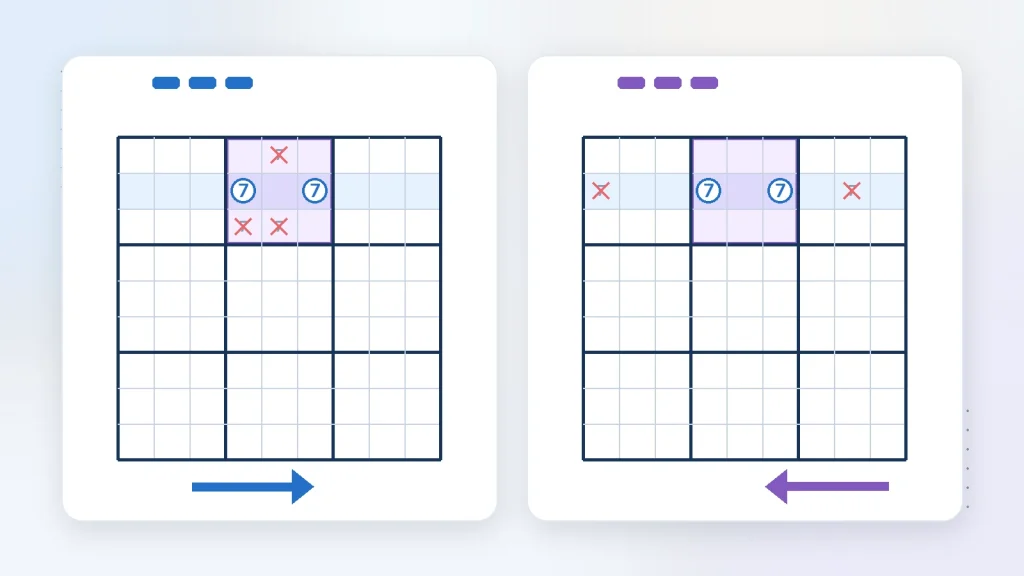
Although the underlying logic is straightforward, several mistakes can lead to incorrect eliminations.
Removing candidates before checking the entire line
Suppose you find two possible 8s within one box.
That is not enough to establish Box-Line Reduction.
You must first verify that no other cell in the same row or column can contain 8.
If another valid position exists in a different box, the claiming condition is not satisfied.
Always check the complete line before eliminating anything.
Eliminating from the wrong region
For Box-Line Reduction, eliminations happen inside the claimed box, outside the row or column that contains the restricted candidates.
Removing the digit from unrelated cells elsewhere on the board is not justified by this technique.
A good habit is to identify the source line, locate the shared box, and only then determine the cells where the candidate can be crossed out.
Removing the candidates that form the pattern
If 6 is restricted to R3C1 and R3C3, those two positions must remain possible until additional information resolves them.
You cannot remove 6 from either position merely because you’ve identified a claiming pair.
The technique tells you where 6 must be located, not which of the two cells contains it.
Confusing claiming with Naked Pairs
A Naked Pair consists of two cells sharing the same two candidates within a common unit.
A Claiming Pair involves one digit whose only possible positions in a line fall within the same box.
Those two cells may contain different additional candidates.
For example, {2,6} and {6,9} could form the basis of a Claiming Pair for 6 if they are the only possible 6s in the line and share a box.
They are not a Naked Pair because their candidate sets differ.
Expecting an immediate number placement
Sometimes Box-Line Reduction removes only one candidate without revealing an obvious answer.
That doesn’t mean the move was useless.
A single candidate elimination can become important later, particularly when combined with another restriction in the same row, column, or box.
Sudoku often progresses through several small deductions rather than one dramatic move.
How Box-Line Reduction Helps Solve Harder Sudoku
Hard Sudoku puzzles frequently contain cells with multiple legal candidates.
The challenge is no longer simply identifying which number is missing from a row. You need to understand how possible numbers interact across different regions.
Box-Line Reduction is valuable because it connects two Sudoku constraints at once.
A restriction within a row can eliminate candidates in a box. That elimination may reveal a Hidden Single, which then reduces the available positions in another row or column.
Sometimes one deduction triggers several more.
For example, imagine that a Box-Line Reduction removes candidate 5 from a cell containing {3,5}.
The cell becomes a Naked Single with value 3.
Placing that 3 may remove candidate 3 from several neighboring cells.
One of those cells might then become a Hidden Single, or a Naked Pair might appear elsewhere.
The original Box-Line Reduction didn’t solve the entire puzzle, but it started a chain of logical progress.
This is why experienced players pay close attention to candidate eliminations even when they don’t immediately produce a completed cell.
A Practical Routine for Hard Sudoku
When you reach a difficult position, avoid scanning randomly.
First, check whether any new Naked Singles or Hidden Singles are available.
Then look at the rows and columns containing relatively few missing digits. These often provide the clearest candidate restrictions.
Select one missing digit and examine all its possible positions within the chosen line.
If the positions are confined to a single box, check whether you can eliminate that digit from other cells in the box.
After applying an elimination, return to the affected cells and look for new singles.
If nothing useful appears, continue with another digit or another line.
You can then examine the boxes for Pointing Pairs, which use the complementary restriction.
This back-and-forth approach is more efficient than looking for increasingly complicated patterns before checking simpler candidate interactions.
As your pattern recognition improves, you’ll begin spotting many of these restrictions almost automatically.
Practice: Can You Find the Box-Line Reduction?
Let’s try a small exercise.
You’re examining row 7 of a Sudoku puzzle.
The number 5 is missing, and its only possible positions in that row are:
R7C1 and R7C3.
Both cells belong to the bottom-left box, covering rows 7–9 and columns 1–3.
Suppose candidate 5 also appears at R8C2 and R9C1.
Question: Can you eliminate either of those candidates?
Solution
Yes. Both candidates can be removed.
Because row 7 must contain a 5, and its only possible positions are R7C1 and R7C3, the bottom-left box must receive its 5 somewhere in row 7.
Therefore, R8C2 and R9C1 cannot contain 5.
Remove candidate 5 from both cells.
Keep the 5 candidates in R7C1 and R7C3 until another deduction determines which one is correct.
Now consider a slightly different situation.
Suppose row 7 also allowed 5 at R7C5.
Would the same eliminations still be valid?
No.
R7C5 belongs to a different box, so the digit 5 is no longer confined to the bottom-left box within row 7.
That additional possibility breaks the claiming pattern.
The exercise illustrates the most important rule: every possible position for your chosen digit in the source row or column must belong to the same box.
Practice Box-Line Reduction on SudokuOnline.mobi
Understanding a technique is useful, but recognizing it in a real puzzle takes practice.
A good starting point is Medium Sudoku, where you can develop stronger candidate-scanning habits without immediately encountering the most complicated patterns.
Once you can recognize claiming pairs and triples consistently, move on to Hard Sudoku.
When solving, try the following approach: use basic singles first, keep your pencil marks current, then check rows and columns for digits restricted to one box.
Don’t rush to fill a number after making an elimination. Take a moment to understand why the candidate was impossible.
That small habit can improve both accuracy and pattern recognition.
If you need a broader overview of related strategies, the Sudoku Solving Techniques guide explains how simpler deductions connect with more advanced methods.
Frequently Asked Questions About Box-Line Reduction
Is Box-Line Reduction an advanced Sudoku technique?
It is generally considered an intermediate technique. It is more involved than finding Naked Singles or Hidden Singles, but it does not require complicated chains or guessing. Many players learn it while progressing from Medium to Hard Sudoku.
What is the difference between Box-Line Reduction and Pointing Pairs?
Box-Line Reduction starts with a row or column and identifies a digit confined to one box. Pointing Pairs start with a box and identify a digit confined to one row or column. The two techniques eliminate candidates in opposite directions.
Is Box-Line Reduction the same as Claiming Pairs?
Yes, Claiming Pairs are a specific form of Box-Line Reduction involving two possible positions for a digit. When three possible positions remain in the same box, the pattern may be called a Claiming Triple.
Can Box-Line Reduction work with three candidates?
Yes. If all three possible positions for a digit within a row or column lie in the same 3×3 box, that digit can be eliminated from other cells in the box outside the line.
Does Box-Line Reduction always reveal a number?
No. The technique removes candidates rather than necessarily placing a digit. Sometimes it creates a Naked Single or Hidden Single immediately; other times the benefit becomes apparent after additional logical steps.
Can I use Box-Line Reduction without pencil marks?
Yes, but it can be more difficult. Pencil marks make it easier to confirm that every possible position for a digit in a row or column belongs to the same box. Accurate candidate notes are especially helpful in harder puzzles.
Is Box-Line Reduction useful in Easy Sudoku?
It can appear in an easy puzzle, although simpler techniques are usually sufficient. Box-Line Reduction becomes more valuable as obvious singles become less frequent.
What should I do after finding a Box-Line Reduction?
Remove the justified candidates from the affected box, update your notes, and check for Naked Singles, Hidden Singles, pairs, or another locked-candidate pattern. The next useful deduction may appear in a different part of the grid.
Can Box-Line Reduction be used in Killer Sudoku?
Yes. Killer Sudoku follows the standard row, column, and box uniqueness rules, so Box-Line Reduction remains valid. However, Killer Sudoku also includes cage constraints that can produce additional candidate restrictions.
What if Box-Line Reduction doesn’t produce any elimination?
You may have identified a valid restriction, but the other cells in the box might already lack that candidate. In that case, there is nothing new to remove. Continue scanning for another pattern rather than forcing a move.
Final Thoughts
Box-Line Reduction is one of those Sudoku techniques that feels much simpler once you’ve seen it work.
You don’t need to know exactly where a number belongs. You only need to recognize that every possible location within a row or column falls inside the same box.
That restriction is enough to eliminate the number from the rest of the box.
The next time your puzzle seems stuck, don’t immediately search for a complicated strategy. Look carefully at the remaining candidates in each row and column. A small group of possibilities confined to one box might be the clue you’ve been missing.
With regular practice, Box-Line Reduction becomes a natural part of solving harder Sudoku puzzles, helping you move forward logically instead of relying on trial and error.