
A naked single is an empty Game Sudoku Online cell with exactly one legal candidate remaining. Find it by checking the numbers already used in the cell’s row, column, and 3×3 box. If those three units rule out eight numbers, the remaining number can be placed without guessing.
This deduction matters because one correct placement can reveal more singles nearby. Check all three units before entering a number, then update the affected candidates and scan again.

What makes a naked single?
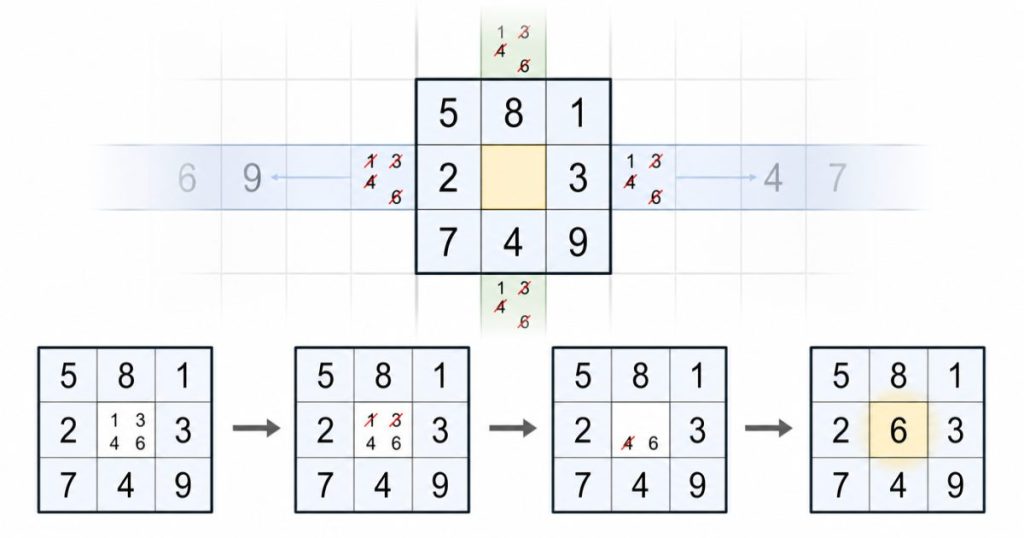
Classic Sudoku uses the numbers 1 through 9, with each number appearing once in every row, column, and 3×3 box. A blank cell may initially allow several numbers, known as candidates. Candidate elimination removes any number that already appears in the cell’s row, column, or box.
When only one candidate remains, the cell is a naked single. For example:
- The cell’s row already contains 1, 3, 5, 6, and 8.
- Its column contains 2 and 9.
- Its 3×3 box contains 7.
These numbers rule out every value from 1 through 9 except 4, so the cell’s candidate set is {4}. The 4 is logically proven and can be placed.
Checking only the row and column is not enough. The 3×3 box may eliminate the final alternative, so all three units must be considered.
How to find a naked single step by step
- Choose an empty cell. Start with a cell surrounded by many given numbers, since it is more likely to have a short candidate list.
- Check its row. Cross out every number from 1 to 9 that already appears in the same row.
- Check its column. Remove the numbers already used above or below the cell.
- Check its 3×3 box. Remove any numbers already present in the cell’s box.
- Count the candidates. If exactly one number remains, you have found a naked single. If two or more remain, the cell is not a naked single.
- Verify before placing it. Confirm that the number does not duplicate another number in the row, column, or box.
A candidate set such as {4} is a naked single. A set such as {2, 4, 7} is not, even if 4 seems more likely than the others. Do not turn a likely number into a definite placement without a logical reason.
Notes or pencil marks can make this process easier on an online Sudoku board. Enter the possible candidates in a blank cell, remove them as the puzzle develops, and watch for a cell whose notes shrink to one number. The guide on using Sudoku pencil marks effectively explains how to keep those notes useful instead of letting them clutter the grid.
What to do after placing a naked single
After placing the number, update the three areas it affects:
- the cell’s row
- the cell’s column
- the cell’s 3×3 box
Remove the placed number from the candidate notes of every empty cell in those areas. Then rescan them for new naked singles. A cell that previously had {2, 4} may now have only {2} after you place a 4 nearby.
For example, if you place 4 in the middle-right box, no other empty cell in that box can contain 4. The same applies to empty cells in the 4’s row and column. This update may reveal another single and create a chain of straightforward deductions.
Online mistake checking can tell you whether a placement conflicts with the puzzle’s solution or an existing number, but it does not replace candidate checking. A move can be legal and still be unsupported if you have not shown why that cell must contain the number.
Naked singles and hidden singles are different
Both techniques can produce an obvious-looking move, but they use different logic.
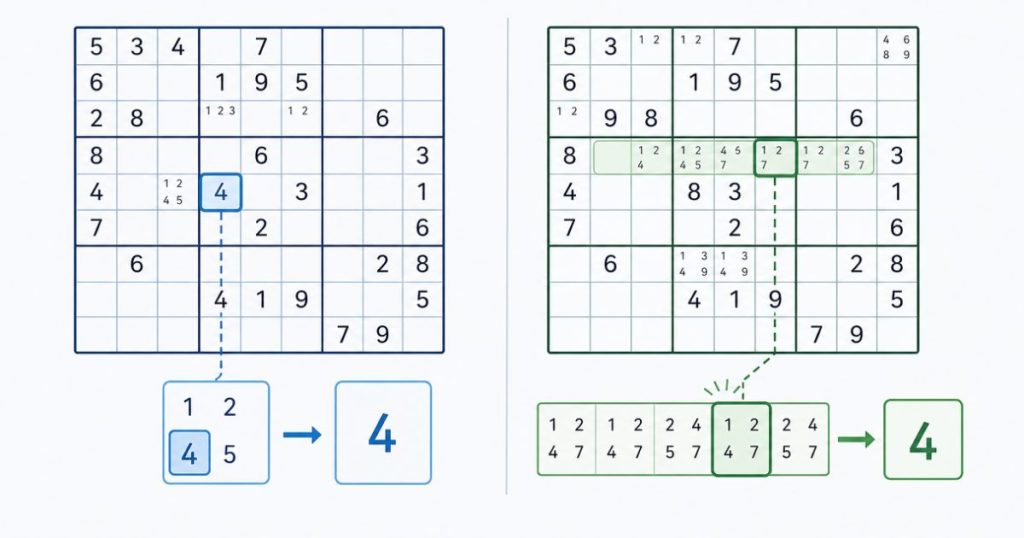
| Technique | What is unique? | Example |
|---|---|---|
| Naked single | One cell has only one candidate. | A cell’s candidates are {4}. |
| Hidden single | One number has only one possible cell in a row, column, or box. | Several cells have multiple candidates, but only one can contain 7. |
Imagine three empty cells in a row with candidate sets {2, 5}, {1, 5, 8}, and {1, 2, 8}. None is a naked single because every cell has more than one candidate. But if 5 appears in only the first cell’s candidate set, that cell is a hidden single for 5 in the row.
The distinction is simple: naked singles focus on the candidates inside one cell, while hidden singles focus on where one number can go within a unit.
Where to scan when no naked single is obvious
Naked singles may appear throughout an easy puzzle, but they are not guaranteed at every stage. If a full scan finds no cell with one candidate, do not guess. Try this focused routine:
- Scan cells in rows, columns, or boxes that already contain many numbers.
- Review your candidate notes and remove values made impossible by recent placements.
- Look at each number from 1 to 9 within a row, column, or box to search for hidden singles.
- Check the grid for a transcription or earlier placement mistake if the candidates seem inconsistent.
Some puzzles require more advanced techniques after the easy singles run out. Naked singles remain useful because later deductions can create new ones. Rescan after each confirmed placement rather than assuming the first scan tells you everything.
Frequently Asked Questions
How many candidates must a cell have to be a naked single?
Exactly one legal candidate must remain after checking the cell’s row, column, and 3×3 box.
Can I identify a naked single by checking only the row and column?
No. The 3×3 box must also be checked because it may eliminate additional candidates.
What should I do if no naked singles are available?
Update your notes, look for hidden singles, and review the grid for mistakes. More advanced puzzles may require other solving techniques.
To find a naked single, examine one empty cell and eliminate the numbers already present in its row, column, and 3×3 box. Place the number only when one candidate remains, then update the three affected units and scan again.
Use notes to manage candidates, but keep the proof clear: one cell, one remaining legal number. If no naked single appears, look for hidden singles or another suitable technique instead of guessing.


