At first glance, Sudoku difficulty seems easy to judge.
A puzzle with lots of numbers already filled in should be easy. A nearly empty grid should be hard.
That sounds logical — but it is not how Sudoku difficulty really works.
The number of clues can influence a puzzle, but it does not determine how difficult that puzzle is to solve. A Sudoku with relatively few givens can collapse quickly with basic logic, while another puzzle with more starting numbers may force you to use advanced techniques several steps deep.
Sudoku publishers and solving programs generally rate difficulty by looking at the logic required to reach the solution, not simply by counting how many cells are filled at the beginning. Conceptis, for example, explicitly notes that puzzles with many clues can be very difficult and puzzles with few clues can be easy. HoDoKu similarly grades puzzles according to the techniques and solving steps required.
So what actually makes a Sudoku puzzle hard?
The answer is more interesting than the number of empty squares.
The Short Answer

A Sudoku becomes difficult when the next correct move is hard to identify logically.
Difficulty is influenced by factors such as:
- the solving techniques required;
- how deeply several deductions must be connected;
- how many obvious moves are available;
- the placement of the starting clues;
- how candidates interact across rows, columns and boxes;
- whether advanced patterns are required;
- and how often progress stalls before a new deduction becomes visible.
The number of clues matters much less than most beginners expect.
A 24-clue Sudoku is not automatically harder than one with 30 clues.
And a 17-clue puzzle is not automatically an extreme Sudoku.
What Is a “Clue” in Sudoku?
A clue, also called a given, is one of the numbers already printed in the grid when the puzzle begins.
A standard 9×9 Sudoku has:
- 81 cells;
- 9 rows;
- 9 columns;
- nine 3×3 boxes.
Your goal is to fill every empty cell with a number from 1 to 9 so that each digit appears exactly once in every row, column and 3×3 box.
If a puzzle begins with 30 filled cells, it has 30 clues.
If it begins with 24, it has 24 clues.
It is tempting to assume that fewer clues mean fewer hints and therefore greater difficulty.
Sometimes that is true.
But not always.
Why Fewer Clues Do Not Automatically Mean a Harder Sudoku
Consider two imaginary puzzles.
Puzzle A
Puzzle A has only 24 clues.
However, those clues are placed so effectively that several cells immediately have only one possible value.
One Naked Single reveals another.
That creates a Hidden Single.
A few more obvious eliminations follow, and the puzzle begins to unravel.
Even with relatively few clues, the solve may be straightforward.
Puzzle B
Puzzle B has 30 clues.
Nothing obvious appears.
Most empty cells still have two or three candidates. Singles disappear quickly, and progress eventually depends on recognizing a Locked Candidate, a pair, an X-Wing or another advanced pattern.
Despite having six more clues than Puzzle A, Puzzle B may feel dramatically harder.
This is why experienced Sudoku players do not judge a puzzle simply by how empty it looks.
SudokuWiki likewise notes that clue density is not a reliable indicator of logical difficulty: very easy low-clue puzzles and extreme puzzles with considerably more clues can both exist.
What Actually Determines Sudoku Difficulty?
There is no universal grading system used by every Sudoku website and publisher.
“Hard” on one platform may feel closer to “Expert” on another.
But most serious grading methods have several ideas in common.
1. The Hardest Technique Required
This is one of the biggest factors.
An easy Sudoku might require only:
- Naked Singles;
- Hidden Singles;
- basic scanning.
A medium puzzle may begin introducing:
- Naked Pairs;
- Hidden Pairs;
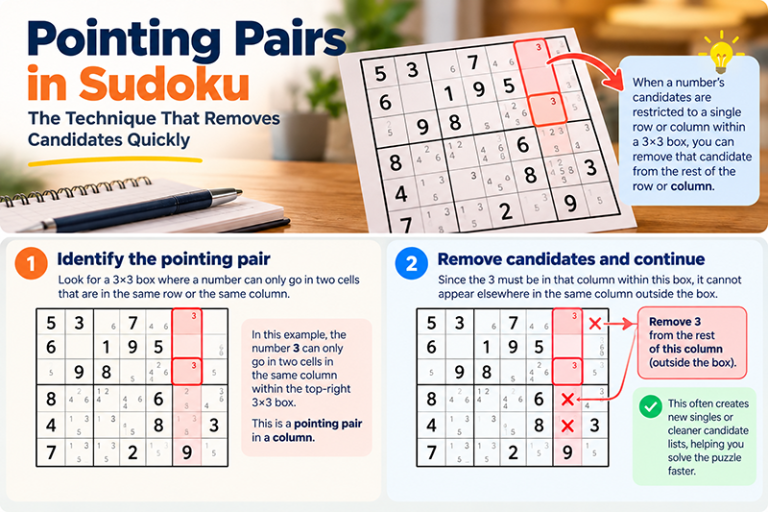
- Pointing Pairs;
- Box-Line Reduction.
A harder puzzle could require:
- X-Wing;
- XY-Wing;
- Swordfish;
- coloring;
- chains;
- advanced candidate eliminations.
If a puzzle cannot be completed without an advanced technique, it will usually receive a higher difficulty rating.
HoDoKu, for example, associates solving techniques with difficulty levels and states that a puzzle cannot be rated below the level of its hardest required solving step.
That makes intuitive sense.
Finding one obvious missing number is very different from recognizing a candidate relationship stretching across multiple rows.
2. The Number of Logical Steps Required
Technique alone does not tell the whole story.
Imagine two puzzles that can both be solved using only basic techniques.
Puzzle A gives you a useful move almost everywhere you look.
Puzzle B repeatedly forces you to scan the entire grid before finding one available single.
Both technically use “easy” logic.
But Puzzle B will probably feel harder.
Why?
Because it requires:
- more observations;
- more candidate checking;
- more intermediate deductions;
- and more time between obvious breakthroughs.
This creates what solvers often experience as logical resistance.
The puzzle does not require an exotic trick — it simply refuses to give up useful information easily.
3. How Many Easy Moves Are Available
This is an underrated part of Sudoku difficulty.
In an easy puzzle, several cells may be solvable at once.
You can look around the grid and immediately find progress.
In a difficult puzzle, there may be only one useful deduction hidden somewhere among dozens of candidates.
That changes the experience completely.
The challenge is no longer:
“Can I solve this cell?”
It becomes:
“Where is the one place on the board where progress is possible?”
This scarcity of productive moves is one reason some puzzles feel much harder even though the techniques themselves are not extremely advanced.
4. The Placement of the Clues
Two Sudoku puzzles can contain exactly the same number of givens and still have completely different difficulty levels.
Why?
Because where those clues are placed matters.
A well-positioned given can constrain:
- its row;
- its column;
- its 3×3 box;
- and indirectly many candidate positions elsewhere.
Another clue may contribute much less immediate information.
So the question is not simply:
How many clues are there?
A better question is:
How much useful logical information do those clues create?
This is one of the biggest reasons clue counting alone fails as a difficulty measure.
5. Candidate Complexity
As Sudoku gets harder, the puzzle becomes less about filled numbers and more about candidates.
Candidates are the numbers that could still legally occupy an empty cell.
An easy cell may have:
{7}
Only one candidate remains, so the answer is obvious.
A difficult part of a grid may contain cells such as:
{2,5}
{2,7}
{5,7}
{2,5,7}
Nothing can be filled immediately.
Instead, you have to understand how those candidates interact.
Hard Sudoku often creates large networks of candidate relationships where eliminating one number requires looking beyond an individual cell.
That is where techniques such as pairs, wings, fish and chains become useful.
6. How Deep the Reasoning Must Go
Some Sudoku deductions are direct.
1 cannot go here, 2 cannot go here, so this cell must be 3.
Others require several linked observations.
For example:
If candidate 5 is restricted to these two positions in this box, then it cannot appear in another cell of the same row. That elimination creates a pair elsewhere, which then exposes a single.
No individual step may be impossible.
The difficulty comes from connecting the steps together.
This is one reason advanced Sudoku feels different from beginner Sudoku.
You are no longer simply searching for numbers.
You are following consequences.
7. Advanced Patterns Can Be Difficult to See
Some Sudoku techniques are hard not because the rule itself is complicated, but because the pattern is visually difficult to detect.
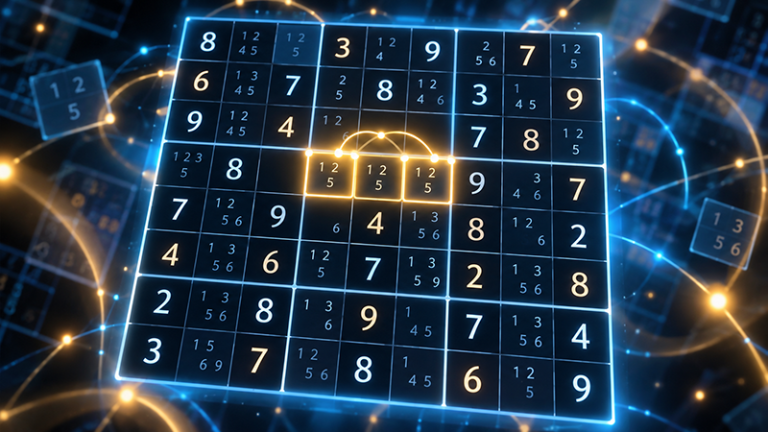
An X-Wing, for example, can involve four cells spread across different parts of the grid.
Swordfish may extend that idea across three rows or columns.
XY-Wing requires tracking candidates across three related cells.
These patterns may be perfectly logical once identified.
The hard part is seeing them among dozens of other pencil marks.
That increases the visual search burden of the puzzle.
8. False Leads Increase Difficulty
Some hard Sudokus contain many patterns that look promising but do not actually lead anywhere.
You may spend time checking:
- a pair that produces no eliminations;
- a row that almost forms an X-Wing;
- a candidate chain that does not close;
- a box that looks constrained but still has multiple possibilities.
The puzzle becomes harder because it forces you to separate useful structure from noise.
Strong solvers become faster partly because they learn which patterns are worth investigating.
9. Difficulty Depends on the Solver Too
Sudoku difficulty is not completely objective.
A puzzle that feels impossible to one player may feel routine to another.
Suppose a puzzle requires an X-Wing.
A beginner who has never learned X-Wing may become completely stuck.
An experienced solver may identify the pattern in 20 seconds.
The grid has not changed.
The solver has.
That is why difficulty ratings should be viewed as guides rather than absolute measurements.
Your own familiarity with solving techniques matters enormously.
Sudoku Difficulty Is Really About the Solving Path

A useful way to think about Sudoku difficulty is this:
The starting grid determines the path of deductions needed to reach the completed grid.
An easy puzzle provides a smooth path.
One answer reveals the next.
Then another.
Then another.
A hard puzzle may force the solver to stop repeatedly and search for a less obvious relationship before the next part of the grid opens up.
That solving path matters more than simply counting the starting clues.
How Many Clues Can a Sudoku Have?
There is no single clue count that defines Easy, Medium or Hard Sudoku.
However, one mathematically important number is 17.
For a standard 9×9 Sudoku with a unique solution, researchers Gary McGuire, Bastian Tugemann and Gilles Civario used exhaustive computer search to establish that no valid 16-clue Sudoku with a unique solution exists. Therefore, 17 is the minimum possible number of clues for a uniquely solvable standard Sudoku.
But this fact is often misunderstood.
Does a 17-Clue Sudoku Have to Be Extremely Hard?
No.
A 17-clue Sudoku has the minimum possible number of givens for a uniquely solvable standard puzzle.
That says something fascinating about the structure of Sudoku.
It does not mean every 17-clue puzzle is exceptionally difficult for a human.
Large collections of 17-clue puzzles contain puzzles of different grades, including comparatively approachable ones as well as very difficult examples.
Once again:
minimum clues ≠ maximum difficulty
Can a Sudoku With 30 Clues Be Harder Than One With 24?
Absolutely.
Suppose the 24-clue puzzle allows a long sequence of:
- Naked Singles;
- Hidden Singles;
- straightforward box scans.
Meanwhile, the 30-clue puzzle quickly reaches a point where none of those techniques work and requires an advanced pattern.
The 30-clue puzzle is likely to be harder for a human solver.
This is one of the clearest examples of why clue count alone is misleading.
How Sudoku Difficulty Ratings Are Usually Created
Different websites use different systems, but a logical rating engine may solve the puzzle step by step using an ordered list of techniques.
A simplified system might work like this:
| Difficulty | Typical techniques |
|---|---|
| Easy | Naked Singles, Hidden Singles |
| Medium | Pairs, basic intersections |
| Hard | Triples, Locked Candidates, more candidate work |
| Expert | X-Wing, advanced interactions |
| Master | Wings, fish, chains |
| Extreme | Deep or uncommon logical patterns |
This is only an illustration.
There is no universal rule saying every platform must use exactly these categories.
In fact, different solving engines can produce different ratings for the same puzzle because they may:
- recognize different techniques;
- apply techniques in a different order;
- assign different scores to each technique.
HoDoKu even notes that changing the order in which solving techniques are applied can result in a different solution path and potentially a different rating.
Why the Same Sudoku Can Feel Easier the Second Time
There is another interesting consequence of technique-based difficulty.
A hard puzzle can become much easier once you know what pattern you are looking for.
The first time through, you may spend ten minutes searching before spotting an X-Wing.
The second time, you recognize the structure immediately.
This is why Sudoku practice works.
You are not simply becoming faster at writing numbers.
You are building a mental library of patterns.
Over time, structures that once looked invisible begin to stand out.
What Makes an Easy Sudoku Easy?
Easy Sudoku generally has a high number of accessible deductions.
You can often solve it mainly through:
- scanning rows;
- scanning columns;
- checking boxes;
- Naked Singles;
- Hidden Singles.
Progress tends to be continuous.
When you enter one digit, another opportunity quickly appears.
Easy puzzles are therefore ideal for:
- beginners;
- learning the rules;
- practicing scanning;
- improving accuracy;
- building confidence.
What Makes a Medium Sudoku Harder?
Medium Sudoku usually reduces the number of immediate singles.
You may need to use pencil marks more consistently and start noticing relationships between candidates.
Common ideas may include:
- Naked Pairs;
- Hidden Pairs;
- Pointing Pairs;
- Box-Line Reduction.
A Medium puzzle often marks the point where players begin to realize Sudoku is not simply about “finding missing numbers.”
It is about eliminating possibilities.
What Makes a Hard Sudoku Hard?
Hard Sudoku often requires longer periods of candidate analysis.
Singles may still appear, but they are usually unlocked by an earlier deduction.
You may need to:
- identify candidate groups;
- examine interactions between boxes and lines;
- keep cleaner pencil marks;
- revisit parts of the grid after eliminations.
This is where Sudoku becomes significantly more strategic.
What Makes Expert, Master or Extreme Sudoku Different?
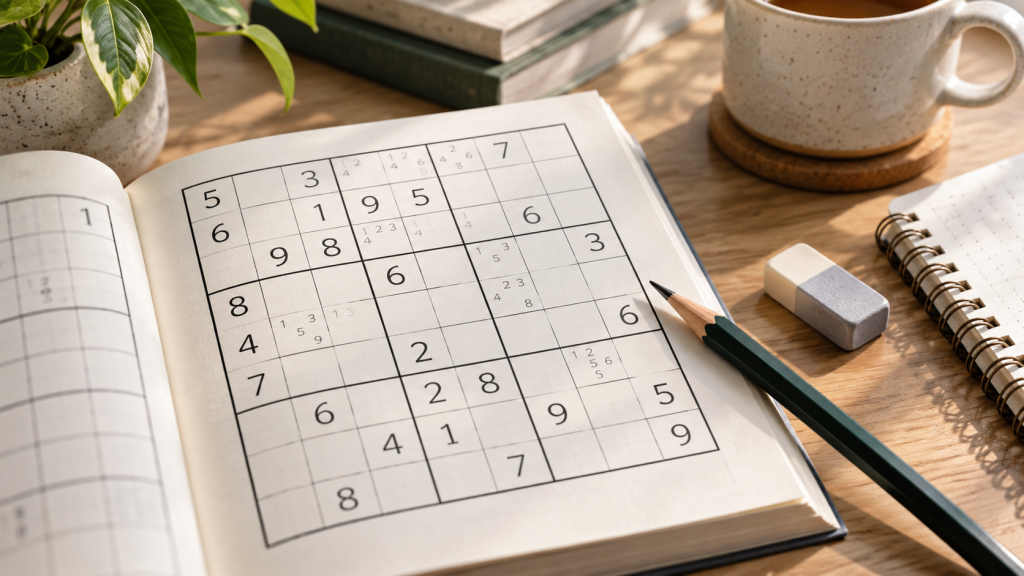
At the highest difficulties, obvious deductions become rare.
The puzzle may require advanced patterns such as:
- X-Wing;
- XY-Wing;
- Swordfish;
- coloring;
- chains;
- other advanced eliminations.
The challenge is often not performing the elimination once the technique is explained.
The challenge is recognizing when and where the technique exists.
Extreme puzzles can contain long stretches where the grid appears completely frozen until one difficult relationship is discovered.
Is Guessing What Makes Sudoku Hard?
A well-constructed logical Sudoku should not need random guessing.
There is an important difference between:
logical assumption used as part of a formal technique
and
randomly entering a number and hoping it works.
When players feel forced to guess, one of several things may be happening:
- an available technique has been missed;
- the puzzle is beyond the solver’s current skill level;
- pencil marks are incomplete;
- or the puzzle itself is poorly constructed.
For players who want to improve, learning the next logical technique is usually more valuable than relying on trial and error.
Is Computer Difficulty the Same as Human Difficulty?
Not necessarily.
This is an important distinction.
A computer can solve Sudoku using brute-force search, backtracking or sophisticated constraint algorithms.
Humans generally solve Sudoku by recognizing logical patterns.
Those are very different processes.
A puzzle that is awkward for a brute-force algorithm is not automatically hard for a human.
Likewise, a pattern that humans find visually difficult may be trivial for software.
SudokuWiki discusses this distinction directly: clue density can significantly affect brute-force search while remaining a poor general predictor of a puzzle’s human logical grade.
For players, human logical difficulty is usually the more meaningful measurement.
How to Tell How Hard a Sudoku Will Be
You cannot reliably determine the exact difficulty just by looking at the starting grid.
But there are a few useful signs.
Lots of Immediate Singles
Probably easier.
Very Few Productive Starting Moves
Potentially harder.
Heavy Pencil-Mark Dependence
Usually medium or above.
Long Periods With No Obvious Placements
Likely requires more advanced logic.
Advanced Candidate Patterns
Typically signals higher difficulty.
Few Clues
May increase the amount of work — but does not guarantee the puzzle is hard.
The only reliable method is to analyze the actual logical solution path.
How to Get Better at Hard Sudoku
If Hard or Expert Sudoku regularly leaves you stuck, do not jump directly to the most advanced techniques.
Build upward.
Step 1: Master Singles
Be able to find Naked and Hidden Singles reliably.
Step 2: Learn Pairs
Naked Pairs and Hidden Pairs teach you to reason about candidates rather than solved cells.
Step 3: Learn Box-Line Interactions
Pointing Pairs and Box-Line Reduction are extremely useful and relatively easy to recognize with practice.
Step 4: Learn One Advanced Technique at a Time
Start with X-Wing before jumping into complex chains.
Solve puzzles specifically chosen to contain the technique you are learning.
Step 5: Review Where You Got Stuck
If you use a hint, do not simply accept the answer.
Ask:
What pattern did I miss?
That question will improve your Sudoku ability much faster than simply finishing more grids.
Try Different Sudoku Difficulty Levels
One of the best ways to understand Sudoku difficulty is to experience the progression yourself.
On SudokuOnline.mobi, you can move through different levels rather than jumping immediately from beginner puzzles to the hardest grids.
A sensible progression is:
Easy → Medium → Hard → Expert → Master → Extreme
If one level feels comfortable and you can solve it consistently without guessing, move up.
If a higher level feels impossible, step back and learn the technique that is blocking your progress.
Difficulty should challenge you — not turn every puzzle into random trial and error.
Frequently Asked Questions
Does fewer clues mean harder Sudoku?
Not necessarily.
Clue count can influence the puzzle, but the main determinant of human difficulty is the logical solving path and the techniques required.
A puzzle with more clues can still be harder than one with fewer clues.
What makes a Sudoku puzzle difficult?
A Sudoku becomes difficult when it requires harder-to-find logical deductions, advanced solving techniques, longer candidate chains or very few immediately productive moves.
Is a 17-clue Sudoku the hardest Sudoku?
No.
Seventeen is the minimum known and proven clue count for a standard 9×9 Sudoku with a unique solution, but 17-clue puzzles can have different difficulty levels.
What is the minimum number of clues in Sudoku?
For a standard 9×9 Sudoku with a unique solution, the minimum is 17 clues.
An exhaustive computer search proved that a 16-clue uniquely solvable puzzle does not exist.
Can a Sudoku with 30 clues be harder than one with 20 clues?
Yes.
If the 30-clue puzzle requires more advanced logical techniques, it may be significantly harder despite having more starting numbers.
How are Sudoku difficulty levels calculated?
There is no universal grading method.
Many systems analyze the solving techniques required, the hardest step, the number of logical steps and the overall complexity of the solution path.
Is Hard Sudoku supposed to require guessing?
A properly constructed logical Sudoku should generally be solvable through deduction rather than random guessing.
If you feel stuck, there may be a logical pattern or technique you have not yet identified.
Why do some Sudoku puzzles suddenly become easy after one move?
A single difficult deduction can unlock several easier deductions.
For example, one candidate elimination may create a Naked Single, which creates another single, producing a chain of rapid progress.
This is sometimes why a puzzle feels impossible for several minutes and then suddenly collapses.
Why do different websites rate the same Sudoku differently?
Difficulty systems vary.
Different solvers may use different technique lists, scoring weights or solving orders, so the same puzzle can receive different labels across platforms.
The Bottom Line
So, what makes a Sudoku puzzle hard?
It is not simply the number of clues.
A Sudoku’s real difficulty comes from the logic required to solve it: how obvious the available moves are, which techniques are necessary, how candidates interact, and how many deductions must be connected before progress becomes possible.
That is why:
few clues do not automatically mean hard;
and
many clues do not automatically mean easy.
A 17-clue Sudoku can sometimes be relatively approachable, while a puzzle with 25, 28 or 30 clues may demand much more advanced reasoning.
The best way to judge Sudoku difficulty is not to count the filled cells.
Follow the solving path.
And if your current puzzles are becoming easy, move up one level on SudokuOnline.mobi and see which new technique stops you.
That is usually where the next stage of your Sudoku skill begins.