
A Sudoku that suddenly seems impossible usually isn’t asking you to guess. More often, the next deduction is hidden by an overlooked candidate, incomplete notes, an earlier mistake, or a technique you haven’t used yet.
The safest response is to pause and diagnose the position. Check your latest entries, rebuild the candidates, scan the grid in a fixed order, and move from simple deductions to more advanced patterns. If you still can’t justify a move, use a targeted hint or switch to an easier difficulty rather than relying on trial and error.
Why a Sudoku can feel impossible
Sudoku difficulty isn’t determined only by how many cells are empty. A puzzle with many empty cells can be straightforward if it contains plenty of singles. Another puzzle with more starting numbers may be harder because its solution depends on pairs, triples, locked candidates, or patterns such as an X-Wing.
Most stuck positions come down to four problems:
- A missed candidate: You may have overlooked a number that can go in only one place in a row, column, or box.
- Incomplete pencil marks: If your notes don’t show every legal candidate, useful relationships can remain hidden.
- An incorrect entry: A number can follow the immediate row, column, and box rules while still being wrong. That mistake may block later deductions.
- A technique gap: The puzzle may have moved beyond basic singles and require a pair, triple, or more advanced pattern.
Feeling stuck doesn’t prove that the grid is broken or unsolvable. Usually, the information on the board needs to be organized and checked more carefully.
A reliable routine for finding the next move
Use the same sequence whenever no number looks obvious. A fixed routine is more reliable than repeatedly staring at the whole board without a plan.

- Stop guessing. Don’t place a number merely because it seems likely. Mark it as a candidate instead.
- Check your recent entries. Start with the last few numbers you placed, especially any that were entered quickly or without a clear deduction. Reconsider whether each one was forced by the information available at that point. If your game includes mistake checking, use it as a diagnostic aid, not as a substitute for understanding.
- Update the pencil marks. For every empty cell, remove numbers already used in its row, column, or 3×3 box. Then add any candidates you may have missed.
- Scan one unit at a time. Inspect a single row, then a single column, then a single box. Look for a number that has only one possible position within that unit.
- Move to pairs and locked candidates. If there are no singles, compare candidate lists instead of searching randomly.
- Consider advanced patterns or ask for help. If basic relationships produce no progress, the puzzle may require a technique beyond your current level.
After every confirmed placement, update the affected row, column, and box. One new number can reveal a move that was hidden during the previous scan.
For a fuller method that combines scanning, notes, and error recovery, see how to solve Sudoku without guessing or starting over.
Check singles before using harder techniques
Singles are the first deductions to revisit because they don’t require complex pattern recognition.
Naked singles
A naked single is an empty cell with only one legal candidate left. For example, if a cell’s row, column, and box already contain 1, 2, 3, 4, 6, 7, 8, and 9, the cell must contain 5.
Naked singles are easy to miss when notes are outdated. A number placed several moves earlier may have eliminated the last alternatives from a cell, so rescan after updating the surrounding candidates.
Hidden singles
A hidden single occurs when a number has only one possible location in a row, column, or box, even though that cell contains several candidates. Suppose three empty cells in a box show:
- Cell A: 2, 5, 7
- Cell B: 2, 4
- Cell C: 4, 6
Here, 5 can appear only in Cell A within that box, so Cell A must be 5. The cell isn’t a naked single, but the number is a hidden single.
When looking for hidden singles, choose one unit and follow one number at a time. This is more reliable than repeatedly scanning the entire grid.
Use locked candidates and pairs to expose progress
Locked candidates
A locked candidate appears when all possible positions for a number inside a 3×3 box lie in the same row or column. That number must occupy one of those cells in the box, so it can be removed from the rest of that row or column outside the box.
For instance, if every possible 7 in the top-left box lies in its middle row, no other cell in that row outside the box can contain 7. Removing those candidates may create a single somewhere else.
The reverse also works. If all possible positions for a number in a row fall inside one box, remove that candidate from the other cells in the box. These eliminations are sometimes called pointing or claiming, depending on the direction of the relationship.
Naked and hidden pairs
A naked pair occurs when two cells in the same row, column, or box contain exactly the same two candidates, such as {3, 8} and {3, 8}. Those numbers must occupy those two cells, so remove 3 and 8 from every other cell in that unit.
A hidden pair is less obvious. Two numbers may appear as candidates in only the same two cells, even if those cells contain additional notes. Remove the extra candidates from those cells, leaving the pair.
Pairs are useful because they turn scattered notes into a firm restriction. If no single appears, inspect units with several cells sharing candidate numbers. Don’t declare a pair just because two cells happen to include the same two numbers. For a naked pair, those cells must contain no other candidates.
When basic deductions stop working
If you have checked singles, locked candidates, and pairs without making progress, the puzzle may require a larger pattern. That doesn’t mean you need to memorize every advanced technique immediately. First, make sure your candidate notes are complete and accurate. Advanced logic built on incorrect notes will only create confusion.
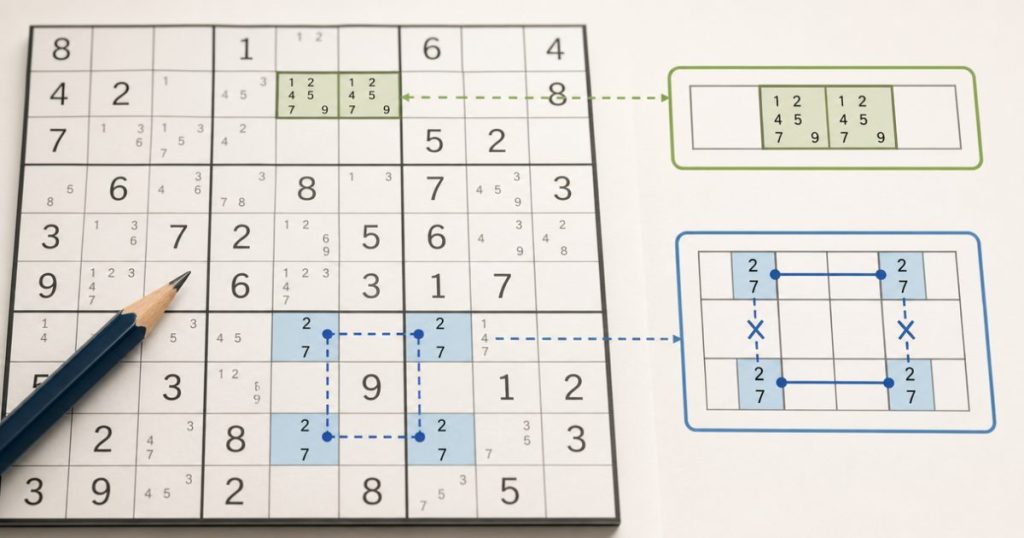
Possible next steps include:
- Naked triples: Three cells in one unit collectively contain only three candidates. Those candidates can be removed from the unit’s other cells.
- Hidden triples: Three numbers are restricted to the same three cells, allowing unrelated candidates to be removed from those cells.
- X-Wing: A candidate appears in exactly two positions in each of two rows, and those positions line up in the same two columns. The candidate can then be removed from other cells in those columns.
An X-Wing is easiest to recognize by focusing on one number rather than the whole grid. Look for two rows where that number has the same two possible columns, or the equivalent arrangement using columns and rows.
There is no fixed order in which techniques must appear. A puzzle may offer a hidden pair before a locked candidate, or require an advanced pattern after several simple moves. The goal isn’t to force a particular technique. It’s to identify a deduction you can explain and verify.
How to tell whether you made a mistake

A contradiction is a warning, not proof that the puzzle has no solution. Check for these signs:
- A row, column, or box contains the same completed number twice.
- An empty cell has no legal candidates left.
- A number has no possible location in a row, column, or box.
- A deduction depends on a candidate you removed earlier without a valid reason.
- The puzzle became unusually difficult immediately after one uncertain placement.
Use the last confirmed deduction as an anchor. Work backward from the point where the grid stopped making sense, checking each entry and its notes. If you can’t identify the error, undo the last uncertain move and rescan. In an online game, mistake checking, undo controls, and saved notes can make this process faster.
Remember that a number can be legal but incorrect. It may not duplicate anything yet, but it can still prevent the completed solution. That’s why “it fits here” is weaker than “every other position for this number has been eliminated.”
When to use a hint or change difficulty
Use a targeted hint after completing your basic checks if you want to learn the next technique. The most useful hint explains the deduction, such as why a candidate is locked or why a pair removes numbers from another cell. If the hint simply gives you an answer, pause and reconstruct the reason before continuing.
Undo the last uncertain move when you suspect an error. Restart only when the grid contains several doubtful entries and tracing them would take longer than beginning again. A restart isn’t a failure. It can be a practical way to practise cleaner note-taking.
Choose an easier puzzle when the current grid repeatedly requires techniques you don’t yet recognize. Choose a harder one when basic singles, pairs, and locked candidates feel routine and you want deliberate practice. Difficulty reflects the logic required, not just the number of clues shown at the start.
If you often lose track of candidates, a short practice routine can help more than jumping straight to extreme puzzles. This guide to getting better at Sudoku without memorizing complicated strategies focuses on consistent scanning and cleaner notes.
The next move in a difficult Game Sudoku Online is usually found by improving the information on the board, not by taking a bigger guess. Check recent entries, refresh every affected candidate list, and scan rows, columns, and boxes in a deliberate order.
If singles, locked candidates, and pairs produce nothing, look for a more advanced pattern or use a targeted hint. When the puzzle is beyond your current technique level, switching difficulty can turn frustration into useful practice.


