Sudoku has a vocabulary of its own, and nobody hands it to you when you start. Guides tell you to “find the naked single in the third house” or warn that a cage has “only one valid combo”, and the sentence is useless if three of its words are mysteries. This glossary collects the 30 terms that actually appear in Sudoku guides, apps and discussions, each with a plain definition and, where it helps, a tiny example. Bookmark it and read alongside our how to play Sudoku page; between the two, no beginner guide should ever lose you again.
The grid and its parts
Grid. The whole 9×9 playing area: 81 cells.
Cell. One square of the grid, holding either a solved digit or a set of candidates.
Row. A horizontal line of 9 cells. Rows are often labelled R1 to R9 from the top.
Column. A vertical line of 9 cells, labelled C1 to C9 from the left.
Box (also block or region). A 3×3 square of 9 cells. The grid contains nine boxes.
House. Any complete set of nine cells that must contain 1–9 exactly once: a row, a column or a box. Saying “in this house” means “somewhere in this row/column/box”.
Unit. Another word for a house, used interchangeably in most guides.
Coordinates. A way to name one cell, such as R4C7 (row 4, column 7). Some communities use chess-style labels (A1 to I9) instead; both describe the same cell.
Clues, candidates and solving words
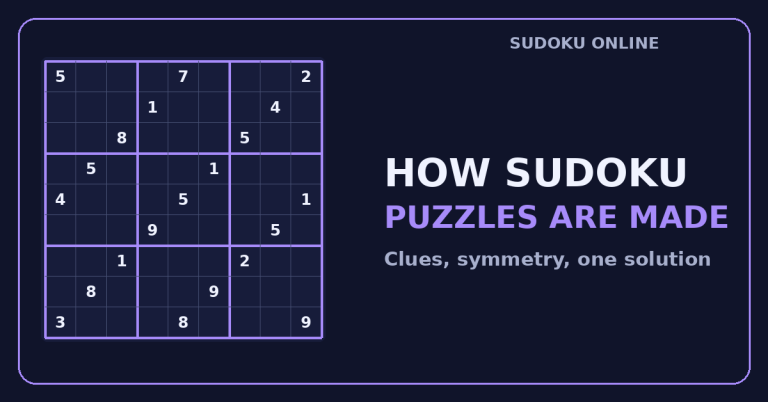
Given (also clue). A digit printed in the puzzle at the start. A classic Sudoku typically opens with 17 to 40 givens.
Candidate. A digit that could still legally go in a cell. “Cell R2C5 has candidates {3, 8}” means only 3 and 8 remain possible there.
Pencil marks (also notes). The small candidate digits you write inside a cell while solving. Our guide to sudoku pencil marks explains when they help and when they just add noise.
Single. A cell or position reduced to one possibility. A naked single is a cell with one candidate left; a hidden single is a digit that fits in only one cell of a house. The full method behind them is the candidate method.
Pair, triple, quad. Two, three or four cells in a house sharing exactly the same two, three or four candidates (naked), or the mirror image, where the same few digits are confined to those cells (hidden). Pairs and triples are the workhorses of medium puzzles.
Elimination. Removing a candidate because logic rules it out. Most of Sudoku is elimination, not placement.
Solve / placement. Writing a digit into a cell as final. Placements trigger eliminations in every house the cell belongs to.
Bifurcation (also trial and error). Guessing one branch of a fork, solving forward, and backtracking if it breaks. Most players treat needing it as a sign they missed a technique. Our Sudoku rules guide shows why a proper puzzle never requires it.
Killer Sudoku terms
Cage. A group of cells outlined with a dashed border in Killer Sudoku. Its digits must sum to the cage total and cannot repeat inside the cage.
Cage total (also cage sum). The small number in the corner of a cage: the required sum of its digits.
Combination (also combo). A specific set of distinct digits that adds up to a cage total, such as {7, 9} for a two-cell 16-cage.
Rule of 45. The deduction that every house totals 45 (1+2+…+9). Comparing cage totals with 45 reveals cells inside or outside a house.
Innie and outie. In Rule of 45 work, an innie is a cell inside a house but outside the cages being summed; an outie is a cell outside the house that belongs to a cage mostly inside it. Innies and outies are usually the direct result of the subtraction.
Puzzle and community words
Difficulty rating. A label (easy, medium, hard, expert…) describing how advanced the hardest required technique is, not simply how few givens a puzzle has.
Minimal puzzle. A puzzle where removing any single given would create multiple solutions; no clue is redundant.
Unique solution. The property that exactly one completed grid satisfies the puzzle. Every properly published Sudoku and Killer Sudoku has it.
Variant. A Sudoku-family puzzle with extra rules: Killer is the best known, alongside others like Thermo, Sandwich and Kropki Sudoku.
PB (personal best). Your fastest recorded solve time at a given difficulty, the number most daily players quietly chase.
Frequently Asked Questions
What is the difference between a box, a block and a region?
None. All three words name the same 3×3 area. American publications often say region or block; British ones usually say box. Guides on this site use “box”.
Why do solvers say “house” instead of just naming the row or box?
Because many techniques work identically on all three kinds of unit. Saying “this digit appears twice in the house” states a rule once instead of three times, and experienced readers instantly apply it to whichever unit is in front of them.
Which terms should a beginner learn first?
Given, candidate, single, pair and elimination. Those five unlock almost every beginner guide ever written. Add cage, combination and Rule of 45 the day you try your first Killer puzzle.
Vocabulary is not trivia in Sudoku; it is the user interface of every technique. Once these 30 words are familiar, guides stop sounding like jargon, patterns get names you can search for, and your solving improves simply because you can finally read the instructions.